
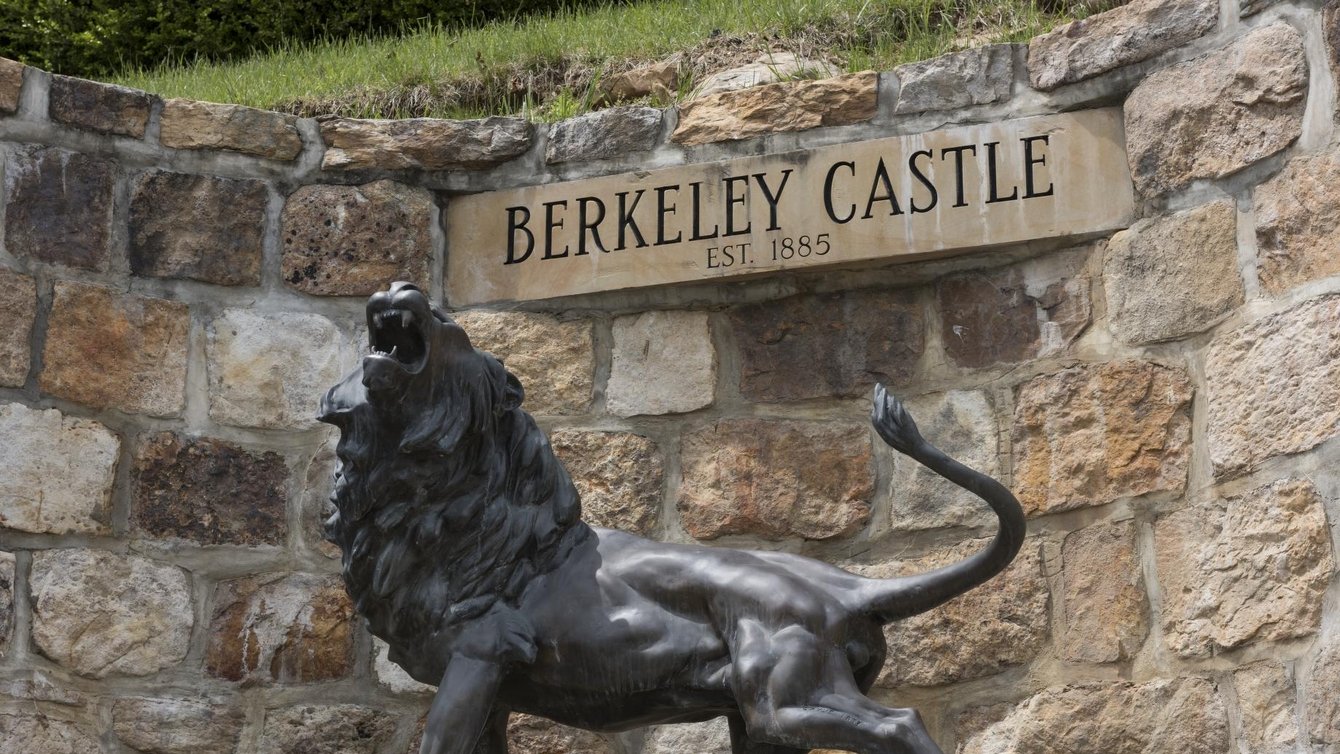
When investigative journalist Michael Edison Hayden learned that the influential White nationalist group VDARE had purchased a 19th-century sandstone castle in Berkeley Springs, West Virginia in 2020, he headed to the 700-person town from his home in New York state.
At the time, Hayden was a senior investigative reporter and spokesperson at the Southern Poverty Law Center (SPLC), where his job was to track, monitor, and raise awareness about the growing threat of White nationalism and A term widely used in both academia and media to indicate beliefs, movements, and policies that limit or discourage immigration, particularly from racially, ethnically, and religiously diverse countries of origin. Learn more in the U.S. VDARE, a platform for the A term used to describe organizations, movements, ideas, and policies that oppose immigrants and immigration. Learn more and racist Right, was founded by Peter Brimelow in 1999. Brimelow’s wife, Lydia, is its publisher and president of the VDARE Foundation. The organization was named to honor Virginia Dare, a child born in 1587 to English colonists; she has become a symbol for proponents of White nationalism, like the Brimelows, whose Generically used to describe factions of right-wing politics that are outside of and often critical of traditional conservatism. Learn more ideas are now central to Republican politics.
Many Berkeley Springs locals feared that the Brimelows would have a negative impact on their town, a welcoming, niche tourist destination known for its natural hot springs. When Hayden learned this, he wanted to equip them with information about the Brimelows’ beliefs and remind them that people all over the U.S. were, like them, standing up for democracy and fighting against An ideology that assumes a hierarchy of human worth based on the social construction of racial difference. Racism as an ideology claims superiority of the socially constructed category, White, over other racialized categories based on the false idea that race is a fixed and immutable reality. Learn more , An ideology that assumes a hierarchy of human worth based on the social construction of gender difference. Learn more , A form of heterosexism that devalues and scapegoats gay, lesbian, and bisexual people and people in same-gender relationships. Learn more , and Negative and/or bigoted attitudes or actions directed towards trans people. Transphobia can be structural, institutional, interpersonal, and/or internalized. Learn more .
It’s a tense set-up, and the conflict between those who support the Brimelows and those who do not is at the center of Hayden’s first book, Strange People on the Hill: How Extremism Tore Apart a Small American Town (Bold Type Books, 2026). Along with its detailed scrutiny of VDARE, the book offers a moving look at the toll that constant immersion into the work and ideology of racist groups took on Hayden’s mental and physical health. It also addresses the lack of support he received from SPLC administrators and zeroes in on his firing after he signed a letter in support of Palestinian rights following the October 7th attack and Israel’s war on Gaza.
This makes Strange People on the Hill a hybrid: part memoir, part political analysis, and part profile of Berkeley Springs and its people.
Hayden spoke to reporter Eleanor J. Bader for PRA several weeks before the book’s April publication.
PRA: How did you become interested in reporting on the domestic White nationalist movement?
Michael Edison Hayden: I got into journalism almost accidentally. In 2010, my then-wife’s dad became extremely ill. He did not have much time left, so we went to India, where he lived, to be with him. At the time, many newspapers were laying off their full-time foreign correspondents, and I ended up spending five years freelance writing for outlets including The New York Times, The Wall Street Journal, Los Angeles Times, and National Geographic. When I returned to the U.S. in 2015, it was a different country because of Trump. I took a job at ABC News Digital. As a contract worker, I was an outsider, so the editors assigned me the non-Hillary Clinton lanes of political discourse: Bernie Sanders’ campaign, but especially Donald Trump’s [campaign]. I talked to many people who formed Trump’s base of support and was one of the few journalists at ABC’s morning meetings who believed he could win because I was clued in to the dialogue happening online. I saw these online disruptors’ influence and their passion for Trump. Over time, focusing on that community led to an expertise in the Far Right.
You credit Peter Brimelow, VDARE’s founder, with turning Republicans to nativism. How did you see this unfold?
Brimelow did not do this alone, but his work was a template for what would become the Alt Right. His 1995 book, Alien Nation, led to VDARE’s creation in 1999. Both of those things helped provide the intellectual justification for the organized racism we see in the Short for Make America Great Again, the slogan of Donald Trump’s 2016 presidential campaign. Learn more movement today. He and people like Steve Bannon embody that kind of political disruption. They made these ideas pop for younger generations, including people like Stephen Miller.
You write that the 1965 Immigration and Nationality Act, better known as Hart-Cellar, was one of the underpinnings of the movement because it allowed more immigrants from outside Western Europe to enter the U.S. How did Brimelow use this to build VDARE?
Brimelow always claims the bill hoodwinked Americans into accepting the idea of mass immigration as a social good. He’s correct when he says that Hart-Cellar transformed the demographics of the country—my own birth to an immigrant mother is a product of Hart-Cellar—but people like him point to the Act as a grievance point and make it seem as if without the Act the lives of “real Americans” would be better and easier. It’s Blaming a person or group wrongfully for some problem, especially for other people’s misdeeds. Scapegoating deflects people’s anger and grievances away from the real causes of a social problem onto a target group demonized as malevolent wrongdoers. Learn more and a denial of reality.
“People like [Brimelow] point to the [1965 Immigration and Nationality] Act as a grievance point and make it seem as if without the Act the lives of ‘real Americans’ would be better and easier. It’s scapegoating and a denial of reality.”
DonorsTrust played a murky role in VDARE and in pulling together the money for the Brimelows to acquire the Berkeley Springs castle. Can you say more about their role?
DonorsTrust bundles money from wealthy libertarians and conservatives and obscures the origins of that money when making grants to various causes. This allowed those who did not want to put their name to their beliefs to contribute anonymously to further VDARE’s racist agenda; we may never know their names or who they actually are. On a smaller scale, crypto donations to VDARE served a similar purpose.
Brimelow had money when he founded VDARE and I believe he and his wife Lydia were, and are, sincere in their racist, anti-immigrant beliefs. Their rhetoric and talking points have since been picked up by Fox News and other right-wing media. But some donors to groups like VDARE are less ideological and promote these beliefs to hold on to the power they have.
In addition to immigrants, Brimelow and the Right have lumped Black Lives Matter (BLM), Antifa, and Queer Pride groups together as threats to straight, White, male hegemony. What role does this antipathy have in riling up the base?
Fictional stories about Antifa loom larger than nonfiction accounts because of the prevalence of right-wing disinformation. The reality is that antifascist movements are fairly small, and activists are scattered throughout the country. Despite what Brimelow, Bannon, Miller, and others would have us believe, there are no organized Antifa, LGBTQIA+, or BLM cells. Right-wing propagandists are rewarded for creating these stories. We don’t know who funds them but we do know that White, male supremacists like Jack Posobiec—infamous for the Pizzagate lie—have conjured stories suggesting that Antifa is one widespread organization.
“Fictional stories about Antifa loom larger than nonfiction accounts because of the prevalence of right-wing disinformation.”
As you got more immersed in working with people in Berkeley Springs, the threats against you ramped up. Can you describe this escalation?
Peter Brimelow is not single-handedly responsible for all the threats I faced, but he did give a platform to Jason Kessler, a White nationalist who helped stage the 2017 Unite the Right rally. Brimelow [allowed] Kessler to publish details about me and my family that were inaccurate and put us in danger.
It’s worth noting that when my former SPLC colleagues and I wrote about the White nationalist movement, we never published family members’ names or locations. Brimelow and Kessler not only wrote about me but linked to my sister’s Instagram account and ran a picture of me carrying one of my sons on my shoulder. Brimelow also published photos of my parents and emphasized my racial make-up, noting that my mom is from Egypt.
Random people used to send me photos of Alan Berg, a Jewish radio host who was killed by a racist group, The Order, in 1984. It was clearly meant as a warning and it was devastating. During the peak of the abuse, I got hundreds of messages that said I was going to be killed. The messages started when I took the job at SPLC in 2018—two years before the Brimelows bought the castle—and lasted for five years, peaking in 2023.
You write that the attacks left you feeling depressed, anxious, and even suicidal, and sent you to the hospital for in-patient psychiatric care. It sounds harrowing. How are you doing now?
I’m doing well. I’m teaching journalism, writing books, and I co-host a podcast with Jared Holt called Posting Through It. But when I got sick, there were a bunch of contributing factors. My wife and I separated amicably after nearly 20 years together. Still, the stress of decoupling was a lesser factor than the impact of absorbing years of death threats. SPLC management knew I was struggling with these threats but gave me no support, and pushed me out following a conflict over my support for Palestinian rights. I later successfully threatened suit over The act of favoring members of one community/social identity over another, impacting health, prosperity, and political participation. Learn more and got a financial settlement.
I ended up spending three weeks in the hospital after that. I wrote the opening lines of Strange People on the Hill while hospitalized.
Wow. I’m glad you’re okay. Let’s return to Berkeley Springs. Did the Brimelows move there intentionally or serendipitously?
Just before the Unite the Right rally, Peter [Brimelow] had been planning a VDARE conference that was supposed to take place in Colorado Springs. But three days after the rally, the venue cancelled his reservation, so he needed a new location. He wanted to bring movement people together under one roof without fear of cancellation or that antifascist protesters would swarm the place.
“[Brimelow] wanted to bring movement people together under one roof without fear of cancellation or that antifascist protesters would swarm the place.”
Lydia found the castle listed for sale on Zillow. It cost $1.4 million and was in Morgan County, West Virginia, a mostly White area with many Trump and MAGA supporters. They did not consider that Berkeley Springs, while part of the county, is a tourist town sustained by visitors from [predominantly] liberal cities.
What motivated you to go to Berkeley Springs for the first time?
I wanted to give people who were upset about the Brimelows’ arrival a pep talk and remind them that people across the country share their concerns about VDARE and White nationalism. Realistically, I knew they were facing a difficult situation because the Brimelows had money and had purchased private property, which limited what locals could do to oppose them. But I wanted them to know they were not alone in supporting inclusivity and valuing diversity.
In addition to working with folks in Berkeley Springs, you and your SPLC colleagues covered other White nationalist activities. What did this teach you?
The main thing was seeing how rhetoric that was once fringe and articulated by shitposters on 4Chan in 2016 has penetrated the Republican party. People with neo-fascist beliefs are now central to the conservative movement. The danger lives in what they can do with the unprecedented power and popularity they have amassed. People on the Right have been fed a steady diet of inflammatory material about leftists, Antifa, BLM, and the queer community, and have been told journalists are an enemy of the people. This messaging has been so thoroughly absorbed that it’s possible when Border Patrol and ICE agents see people like Alex Pretti and Renee Good, for example, their first reaction is to shoot to kill. I view their deaths as a direct consequence of the normalization of far-right commentary.
“People with neo-fascist beliefs are now central to the conservative movement. The danger lives in what they can do with the unprecedented power and popularity they have amassed.”
VDARE is now gone thanks to the New York Attorney General. How did her office close them down?
The Attorney General saw that VDARE was registered as a charitable nonprofit in New York. The office scrutinized their financial records and [sued] the group over abuse of charitable assets they’d collected. The case is ongoing, with the AG’s office seeking restitution and penalties for misusing approximately $2 million in contributions.
As far as I know, Peter and Lydia are living on a property connected to the castle. They’ve largely been forgotten now that VDARE is defunct. But it’s worth noting that a phantom of VDARE still exists—they still post from the group’s X account, for example.
What do you hope readers will take away from Strange People on the Hill?
More than anything, I want it to be enjoyed as literature. There are clearly challenges to this since some of the topics it covers are news-y and probably trigger a political response. People who have strong feelings about MAGA and White nationalism may find it hard to see the book as a work of art. Still, if they read it and experience catharsis through my struggle, or that of the people of Berkeley Springs, I’ll see the book as a success.