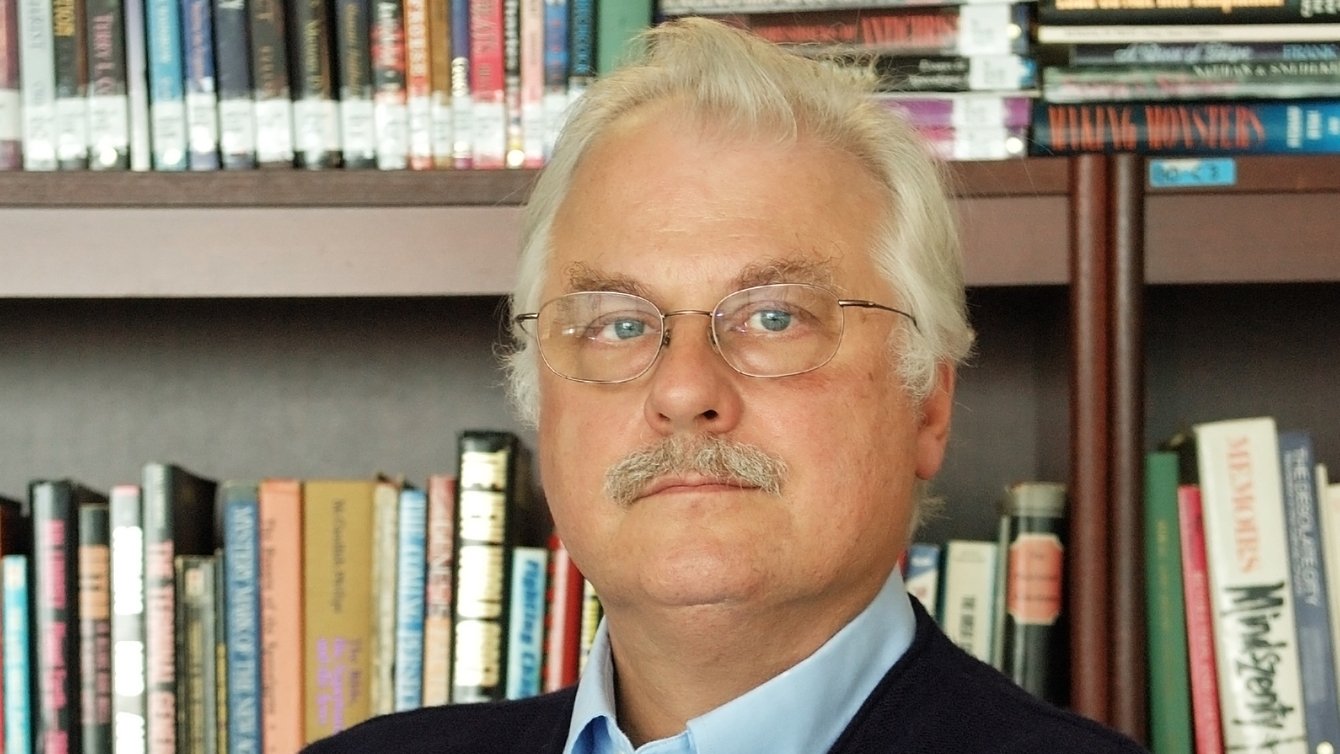
“Hi, It’s Chip Berlet!” said the voice on the old office phone I answered one day in 1984. I had no idea who that was. I also had no idea that my life was about to change slowly, subtly, over time, and that I was speaking to a man who would make important contributions to how we have come to think about anti-democratic movements, ideologies, and organizations in this country and internationally.
Chip was calling from Midwest Research in Chicago, an organization that feminist political scientist Jean V. Hardisty had launched to do something that was rare in those days: to produce investigative research and analysis on right-wing movements, and to advise social justice movements defending human rights about them. Midwest Research later moved to Boston and became Political Research Associates, where I am proud to have been working for several years. It was Chip’s long-distance call 40 years ago—just to connect with someone else working in the field—that set me on the path to where I am today.
Chip died in January 2026. He had worked at PRA from its earliest days and for 30 years thereafter. In many ways, he came to define much of what PRA was and continues to be. So much of what we do was either initiated or profoundly shaped by Chip’s life and work.
“In many ways, he came to define much of what PRA was and continues to be. So much of what we do was either initiated or profoundly shaped by Chip’s life and work.”
Chip was known for his photography of A U.S.-based White supremacist, Christian paramilitary group formed during the Reconstruction era. Learn more and neo-Nazi rallies, which were published by major newspapers and used on book and magazine covers, and for his investigative journalism documenting anti-democratic movements. He was also known for his ground-breaking scholarship, notably Right-Wing Populism in America: Too Close for Comfort, which he co-authored with Matthew Lyons. Unsurprisingly, he was a sought-after speaker, media source, and commentator.
I can’t do a full appreciation of the importance and impact of his life’s work at PRA and beyond. (I believe those will come with time.) But I can speak to some of the many places our lives and work intersected, highlight some things that might otherwise get lost, and perhaps more importantly, highlight some of the lessons of his life’s work that are as relevant today as they have been for the past four plus decades.
My friend Chip influenced me in many ways. I admired his fierce commitment to scholarly rigor and the ethics of journalism as he sought to expose anti-democratic elements and advance a broad vision of social justice. (I was, however, never able to illustrate my points with entertaining magic tricks, as he used to do in his public talks.)
Chip published much important work on different aspects of the U.S. Right—helping us categorize it, and understand militias, A form of far-right populist ultra-nationalism that celebrates the nation or the race as transcending all other loyalties. Learn more and the Far Right, Both a system of beliefs that holds that White people are intrinsically superior and a system of institutional arrangements that favors White people as a group. Learn more , A form of top-down political system that concentrates state power in the hands of a single leader and/or group of close allies. Learn more , A form of oppression targeting Jews and those perceived to be Jewish, including bigoted speech, violent acts, and discriminatory policy. Learn more , and the Often used interchangeably with Christian Right, but also can describe broader conservative religious coalitions that are not limited to Christians. Can include right-wing Jews, Muslims, Hindus, Mormons, and members of the Unification Church of Sun Myung Moon. Learn more . I want to highlight a few examples that have been important to me in my work on the A movement that emerged in the 1970s encompassing a wide swath of conservative Catholicism and Protestant evangelicalism. Learn more .
“I admired his fierce commitment to scholarly rigor and the ethics of journalism as he sought to expose anti-democratic elements and advance a broad vision of social justice.”
His 2014 article, “Heroes Know Which Villains to Kill: How Coded Rhetoric Incites Scripted Violence,” warned us about the history of social movements and individuals who demonize scapegoats for their and society’s problems. They not only identify the target but conveniently cast themselves—the demonizers—as the Good Guys: the ones who know what must be done. I have cited this study several times in my writing about threats of violence by the Christian Right generally, and the A movement originally identified and named in the 1990s by evangelical theologian C. Peter Wagner. The NAR has since become the leading political and cultural vision of the Pentecostal and Charismatic wing of evangelical Christianity. Learn more in particular.
“The leaders of organized political or social movements sometimes tell their followers that a specific group of ‘Others’ is plotting to destroy civilized society. History tells us that if this message is repeated vividly enough, loudly enough, often enough, and long enough—it is only a matter of time before the bodies from the named scapegoated groups start to turn up.”
Over four decades, we shared conference panels, co-authored articles, referred reporters to one another, and contributed chapters to each other’s books. I contributed a chapter to his 1999 anthology Eyes Right!: Challenging the Right Wing Backlash, and an essay to the 2021 festschrift, Exposing the Right and Fighting for Democracy: Celebrating Chip Berlet as Journalist and Scholar, edited by Pam Chamberlain, Matthew N. Lyons, Abby Scher, and Spencer Sunshine.
Because his values were rooted in progressive Presbyterianism, I knew he would have much to say in his essay for a 2008 anthology I was asked to compile and edit called Dispatches from the Religious Left: The Future of Faith and Politics in America. He did not disappoint. He wrote,
“When I speak in public about my criticisms of the Religious Right, I often identify myself as someone who is trying to help build a Religious Left.”
This was not always appreciated by those who thought that a Religious Left would be a problem of the same sort. Chip replied,
“On the contrary, I have faith that the resurgence of an authentic, politically dynamic Religious Left will be part of a new broad progressive coalition that will help fulfill the long delayed promise of American democracy for all people, especially those who have historically been oppressed, marginalized, and abandoned by our society.”
He reminded readers that,
“Throughout our history as a nation, Religious Left activists have been fierce advocates for justice and equality and opponents of unfair concentrations of privilege and power. In addition, they have joined with secularists and civil libertarian religious conservatives to defend our Constitutional tradition of separation of church and state.”
He added that “our vision” leads us to seek the “Beloved Community” as envisioned by Rev. Dr Martin Luther King Jr.:
“… the issue is how we craft a pluralist civil society that honors the dignity of both A neutral term used to describe someone or something, such as in law, as non-religious in character. Learn more philosophy and spiritual faith – while insisting that theological claims alone should never dictate public policy. That is why we are challenging In the classical definition, a system in which governmental leaders are clergy. Learn more , because that is what the Christian Right leadership is increasingly sowing: a theocratic society.”
In criticizing the Christian Right and seeking to build a Religious Left, he had no patience for the “counterproductive histrionics” of “stereotyping… conservative evangelicals as a bunch of theocratic fascists.” He also believed that then-fashionable claims of “the imminent collapse of the Christian Right are ahistorical and absurd.”
One area on which Chip and I collaborated was to define the broad ideology of Dominionism on the Christian Right—as well as taking on the organized efforts to pooh-pooh the significance of the movement and discredit those of us who were writing about it. We wanted a definition that would apply fairly and accurately to a broad swath of the Christian Right that embodied and advanced the ideas of religious and political dominion. In further consultation with then-PRA Associate Fellow Rachel Tabachnick, we settled on a simple definition that has gained wide acceptance. Dominionism is,
“The theocratic idea that regardless of theological view or eschatological timetable, Christians are called by God to exercise dominion over society by taking control of political and cultural institutions.”
I was pleased to be able to provide a platform for Chip’s writing outside of PRA and other scholarly and journalistic venues. He created a large body of work at a group blog that Bruce Wilson and I started in 2005, called Talk to Action. Our goal was to publish about the Religious Right and what to do about it. (While the site is now defunct, the content is still available.) Chip was one of the first people I asked to contribute, which he did—171 posts through 2016. Talk to Action provided a platform for our writers to speak independently—and against the grain as necessary. In 2007, for example, Chip was outraged by “…indications that some in the leadership of the Democratic Party, and some of its candidates for public office, are seeking the votes of Christian conservatives by suggesting there is room to compromise on reproductive rights and gay rights.” He would still be outraged (but not surprised) by the same kind of unprincipled politics being played by contemporary pols with presidential ambitions.
He insisted that rights “are not political commodities to be traded for votes.”
“[Chip] insisted that rights ‘are not political commodities to be traded for votes.’”
Similarly, while he despised the coarse labeling and A way of portraying a person or group as malevolent, sinful, or evil; often a precursor to scapegoating and conspiracism. Learn more tactics of the Christian Right, he described himself with his usual self-effacing humor as “an equal opportunity curmudgeon”—in opposing the cheap (but expensively focus- grouped) political labels used by liberal interest groups at the time.
“I think it’s time to stop using phrases such as ‘religious political A generic category for anyone who holds beliefs outside of those approved by mainstream or broadly centrist preferences. Learn more ’ and ‘radical religious right.’ A lot of my friends and allies use this language, but what are friends for if they can’t tell you when they think you are wrong?”
Chip’s politics were grounded in values, not partisanship. At Talk to Action, he took advantage of the opportunity to connect his values and his personal history with his research and writing about the Right to advance social justice.
He was particularly a fan of the “four freedoms” President Franklin D. Roosevelt featured in his State of the Union Address, January 6, 1941. Many Americans came to embrace these as core values that bound the country together during World War II. They were also part of his personal history beyond the speech.
Chip wrote at Talk to Action:
“Years later, battling cancer, my Dad was determined to don his uniform one last time on Memorial Day. As I helped him dress, I asked him about the war. His only reply was to hand me one of his medals. Inscribed on the back were the words “Freedom from Fear and Want. Freedom of Speech, and Religion.” The four freedoms. My Dad fought fascism to defend these freedoms, not just for himself, but for people of different religions and races, people he disagreed with…even people he was prejudiced against.”
So much of Chip’s work is seen through the lens of history: how to avoid the horrors of the past; how to honor our forebears; and how to build a better future. Because that’s so, it is often as fresh and compelling as when it was published. I know he wished for a time when we could look back at all this as history and not continue to live through so many urgent matters of historic significance.
His life and work remain ever present for me.