
In February 2019, Hindu climate activists gathered at Yale University for a conference on “Hindu Earth Ethics & Climate Action.” The event was sponsored by the Hindu American Foundation (HAF) and framed environmental work as dharma—a sacred duty—to protect “Matre Bhumi or Mother Earth.” To many in the room, this looked like a welcome example of faith-based climate activism or leadership.
Yet just a few years later, HAF—the same organization that presents itself as a moral voice on climate—sued California’s Civil Rights Department to block caste-discrimination enforcement, claiming that the state’s approach unconstitutionally defined Hindu religious doctrine and would subject Indians and Hindus to discriminatory treatment in employment. In July 2025, a federal court dismissed the case and called HAF’s The idea that people’s religious views should be neither an advantage or a disadvantage under the law. Learn more arguments “entirely unpersuasive,” affirming that enforcing caste-based protections does not violate Hindu Americans’ rights.
What may be surprising to some progressives is not a side contradiction but a window into how Hindu nationalist networks are using the language of climate action and spiritual ecology to build political and social power in the U.S while reinforcing the same caste hierarchy they defend back in India through a form of ecofascism known as “eco-casteism,” which uses ecological narratives to justify and defend the caste system. This emerging “green dharma” politics—discussed in more detail below — is part of an authoritarian climate project that links Hindu supremacism to Trump-era The contemporary idea that America was founded as—and was intended by God to be—a Christian nation. Learn more . Despite their differences on climate, both movements sacralize hierarchy, recast civil rights protections as attacks on a divinely ordered society, and decide which communities are expendable in the name of saving the nation or the planet.
Green Development as Caste Violence
For Hindu supremacists, Ayodhya, in the Indian state of Uttar Pradesh (UP), is often framed as the heart of a Hindu nation, a symbolic capital restored after the demolition of the 16th-century Babri Masjid and the construction of a Ram Temple in its place. Soon after the temple’s January 2024 opening, Prime Minister Narendra Modi announced a major rooftop solar program called ‘Pradhan Mantri Suryodaya Yojana,’ and the UP state began marketing Ayodhya as its first solar city, holding up roof-top installations and solar parks in the region as proof that India can honor its spiritual heritage while embracing clean energy.
On the ground, however, these projects displace the very communities they claim to uplift. Farmers and Dalit residents who had cultivated leased land for decades were forced to vacate, and their houses were demolished without written compensation agreements or proper notice. One displaced farmer told a reporter, “Where will we go? Where will we all stay?” Another said: “We have no place to go. We are very distressed, sir.” The people whose labor made the land productive are treated as expendable so that the state can showcase Ayodhya’s green transition at the cost of families’ livelihoods.
“The people whose labor made the land productive are treated as expendable so that the state can showcase Ayodhya’s green transition at the cost of families’ livelihoods.”
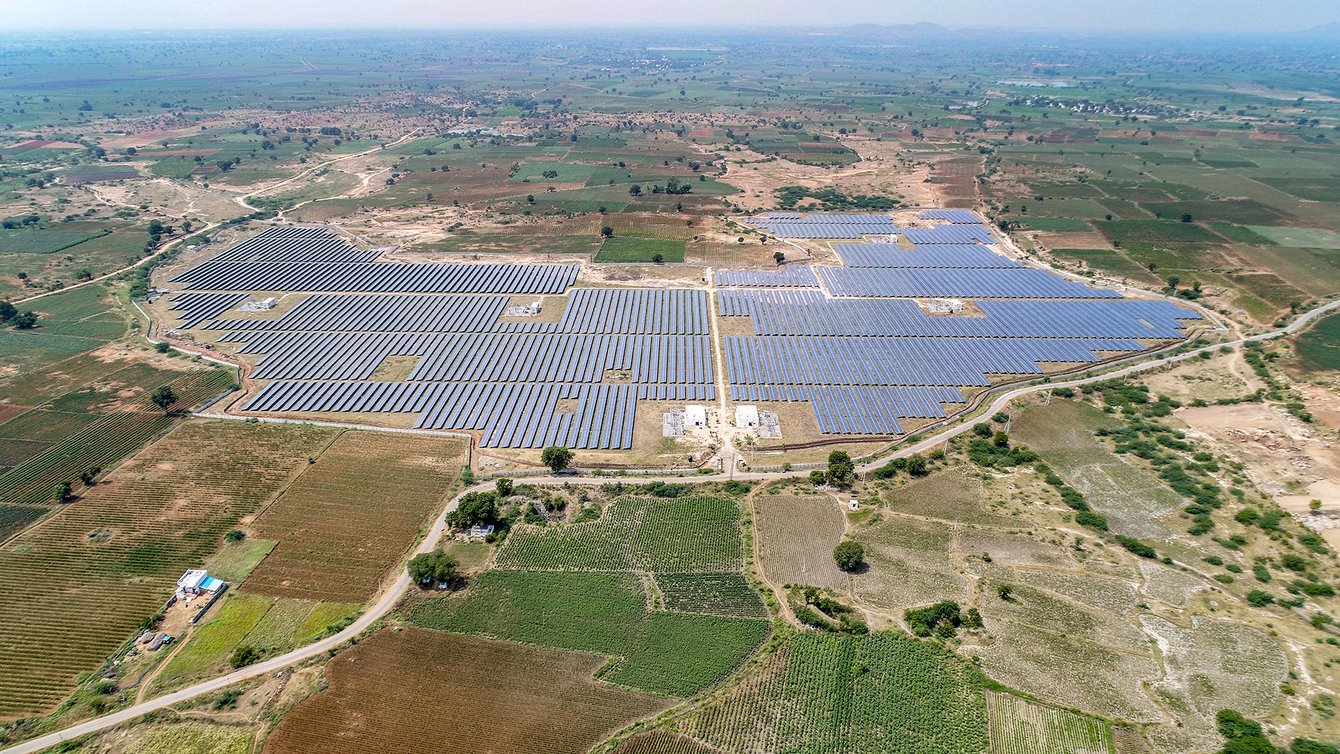
In Karnataka, the state’s Pavagada Solar Park—one of the largest in the world—shows how this pattern scales across rural India. Built across 13,000 acres of land leased from about 2,300 farmers in five drought hit villages, the project is marketed as a win-win situation for farmers as they lease out their land in exchange for annual rent payments. But investigative research shows that many landless agricultural laborers and pastoralists lost their livelihoods because of the park, which has created far fewer jobs than promised, most of them precarious and stratified by caste. Dominant-caste landowners capture rents and contracts, while Dalit and Adivasi residents are pushed into low-wage work like cleaning panels, and pastoralists lose access to grazing lands rebranded as “wastelands.”
From a distance, projects like Ayodhya and Pavagada are celebrated as climate solutions and steps toward net zero. Up close, these green energy projects reproduce familiar patterns of land grabbing and caste-segregated labor. They obscure this violence on a national and global stage by framing care for Mother Earth as a Hindu duty. Scholar Mukul Sharma calls this eco-casteism—the environmental discourse that makes caste hierarchy invisible and uses ideas of nature and ecological order to rationalize caste privilege, with the effect that green projects can displace Dalit, Adivasi, and other marginalized communities off land and out of work under the banner of environmental protection. As The Transnational Institute’s A form of far-right populist ultra-nationalism that celebrates the nation or the race as transcending all other loyalties. Learn more : State of Power 2026 report notes, Sharma’s work shows how Hindu nationalist leaders like PM Modi frame India as an “ancient ecological nation,” using narratives that “cast ethno-religious differences between Hindu and Muslim groups through a lens of purity versus pollution.” At the same time, the Modi government brands itself as a global climate leader with big non-fossil and net-zero targets, even as it expands coal production and plans new coal plants for decades to come. Seen from a decolonial lens, this is not a contradiction but a continuity. India’s green development repeats an older colonial pattern where land is treated as empty, communities as obstacles, and improvement as the rationale for dispossession.
Only now it is solar parks and climate pledges, not dams and mines, doing that work.
“India’s green development repeats an older colonial pattern where land is treated as empty, communities as obstacles, and improvement as the rationale for dispossession.”
U.S Hindutva Networks as Climate Actors
The same pattern of greenwashing caste-denialist and authoritarian politics appears among Hindu supremacists in the U.S.
“Green dharma” or “Green Hinduism” refers to a Hindu environmental ethic that presents caring for the Earth as a religious duty rooted in Hindu scripture—drawing on concepts like ahimsa (non-harm) and seva (service)—and frames Hinduism as naturally ecological and morally ahead of the West. The term circulates within a broader field of global Hindu environmental initiatives. The Bhumi Project, launched in 2009 at Oxford’s Centre for Hindu Studies, was described as a worldwide Hindu response to environmental issues and worked with partners such as HAF on efforts like Hindu Environment Week and the 2015 Hindu Declaration on Climate Change. Bhumi Global was later launched to build on that work and position itself as a leading Hindu environmental hub. “Green dharma” and related “Green Hinduism” language appear in this ecosystem in university workshops like Gopal Patel’s “Green Dharma: Exploring Hindu Texts as Guides to Environmental Action” at Princeton, in concept pieces on Green Hinduism, and in U.S. Hindu advocacy spaces where Hindu scripture is held up as offering distinctive moral guidance for climate action.
HAF presents itself as a mainstream civil rights advocacy and education organization. It co-organized the 2019 “Hindu Earth Ethics and Climate Action” conference at Yale, which brought together Hindu environmental activists, academics, and policy-makers to “claim a mantle of leadership in fighting” climate change and linked Hindu scriptural teachings to everyday climate action. The conference featured one of the lead authors of the 2015 Hindu Declaration on Climate Change, which calls on Hindus to “expand our conception of dharma” to include the Earth, frames climate action as a “dharmic duty”, and opens with a Sanskrit verse declaring “The Earth is my mother and I am her child,” the same vocabulary of Mother Earth, sacred duty, and civilization ecological wisdom that defines “green dharma” politics. To many U.S climate and interfaith groups, HAF seems like a natural partner, in part because it produces policy briefs and educational materials that present Hindu scriptures as a foundation for environmental ethics and climate action. The 2015 declaration calls on Hindus to “expand our conception of dharma” to include the Earth, frames climate action as a “dharmic duty,” and opens with a Sanskrit verse declaring “ The Earth is my mother and I am her child”—the same vocabulary of Mother Earth, sacred duty, and civilizational ecological wisdom that defines “green dharma” politics. To many U.S. climate and interfaith groups, HAF seems like a natural partner.
But HAF is a key node in the global Hindu supremacist movement and actively denies the reality of casteism. A 2024 Savera report published by PRA documents how HAF has longstanding organizational ties to Rashtriya Swayamsevak Sangh-aligned groups like the Hindu Swayamsevak Sangh (HSS) and Coalition of Hindus of North America (CoHNA), defends Modi’s government, and aggressively opposes caste protections in the U.S. When California lawmakers advanced SB‑403 to recognize caste as a protected category, HAF worked closely with right‑wing allies to fight it, arguing in public statements that the bill unfairly targeted Hindus and South Asians and promoted falsehoods about Hinduism, rather than recognizing it as protection for caste‑oppressed workers. Similarly, HAF filed a federal lawsuit against the California Civil Rights Department challenging its caste The act of favoring members of one community/social identity over another, impacting health, prosperity, and political participation. Learn more enforcement in 2022, and later expanded their claims in a second amended complaint filed in 2024. In July 2025, the district court dismissed that second amended complaint without leave to amend, and HAF appealed the decision to the Ninth Circuit, pursuing a legal strategy that, if ultimately successful, would make it harder for Dalit and Bahujan workers to challenge discrimination.
“HAF is a key node in the global Hindu supremacist movement and actively denies the reality of casteism.”
In India and the U.S. diaspora, the Hindutva project also depends on anti‑Muslim politics, casting Muslims as permanent outsiders and security threats through campaigns against “love jihad,” halal food, mosque construction, and Muslim civic organizations such as the Council on American-Islamic Relations (CAIR) and the Indian American Muslim Council (IAMC), in ways that echo Islamophobic narratives in the U.S. Right.
Meanwhile, the Republican Hindu Coalition (RHC), explicitly modeled on the Republican Jewish Coalition, is connecting Hindutva to the Short for Make America Great Again, the slogan of Donald Trump’s 2016 presidential campaign. Learn more Right as a part of a shared authoritarian project. RHC founder Shalabh Kumar reportedly donated up to $4 million to Trump’s campaign and described Modi as “a Trump before Trump,” a comparison shared by Steve Bannon, who praised Modi as a nationalist model and later became honorary chairman of the RHC. During Trump’s second inauguration in January 2025, The American Hindu Coalition’s Presidential Inauguration Hindu Gala, attended by figures from HAF and other organizations, showcased pro-Trump Hindu American leadership and, in line with AHC’s mission to “build a stronger America through Hindu Enlightenment Principles,” cast Trump’ s second term as an opportunity for Hindu-identified values to shape U.S. politics.
From a climate rhetoric angle, HAF’s Yale conference, the Hindu Declaration on Climate Change, and broader talk of so-called “dharmic ecology”—a term used by scholars to describe Hindu religious environmentalism, and a narrative echoed in Hindu nationalist writings that present India as an ancient ecological civilization—all operate in this context.
In principle, the language of “green dharma” could support climate justice. In practice, it is deployed by Hindu supremacist networks that fight caste protections and align with the MAGA Right. The ties between Bhumi Global and U.S Hindutva groups go beyond shared discourse: Mat McDermott, HAF’s Senior Director of Communications, was a co-founder of Bhumi Global and was a lead author of the 2015 Hindu Declaration on Climate Change, described as “ a joint project of HAF and The Bhumi Project.” As HAF shifts to the Far Right, an emerging “green dharma” politics thus serves as a soft‑power bridge between transnational Hindutva and U.S. Christian nationalists who both claim to defend a sacred natural order, cast minority rights and anti‑discrimination law as threats to that order, and use “religious freedom” language to resist egalitarian policy.
“Hindutva and U.S. Christian nationalists both claim to defend a sacred natural order, cast minority rights and anti‑discrimination law as threats to that order, and use ‘religious freedom’ language to resist egalitarian policy.”
Eco-Casteism: Hindutva’s Bridge to Christian Nationalism
Eco-casteism and ecofascism are not identical, but they do the same political work. Both use environmental language to harden social hierarchies and decide whose displacement counts as progress. In India, eco-casteism shows up when green development projects treat Dalit and Tribal communities as expendable in the name of climate goals. In the U.S. and Europe, as PRA’s reporting on ecofascism has documented, Generically used to describe factions of right-wing politics that are outside of and often critical of traditional conservatism. Learn more actors invoke overpopulation, scarce resources, and nature preservation to justify border walls and demographic control. Both decide which populations are worth protecting and worth sacrificing.
What connects Hindutva to the U.S Far Right is not a shared energy policy. Trump’s MAGA coalition has been openly pro-fossil fuel. On his first day back in office, Trump declared a national energy emergency to fast-track drilling. His One Big Beautiful Bill began phasing out tax credits for wind and solar while subsidizing coal, oil and gas on federal lands. His administration is stacked with fossil fuel executives. This is not just greenwashing, but an open promotion of extraction.
The bridge is ideological, not energy-technical. It runs through Christian nationalism, the belief that the U.S. was founded as a Christian nation and should be governed by Christian law. Christian nationalism is not the only ideology animating Trump’s coalition, but it is one of the most powerful currents shaping his regime’s policies, and its dominion theology frames a hierarchy of gender, race, sexuality, and religion as divinely ordained. For example, equality laws are treated as violations of God-given order, not remedies for structural harm. Hindutva does something structurally parallel. It presents caste hierarchy and Hindu majoritarian rule as expressions of cosmic balance and natural law, not as political domination built on centuries of violence.
“[Hindutva] presents caste hierarchy and Hindu majoritarian rule as expressions of cosmic balance and natural law, not as political domination built on centuries of violence.”
A Shared Authoritarian Project
This is what makes it an authoritarian project. Hindutva and Christian nationalism both work to concentrate power in the hands of a few representing a dominant religious bloc; shrink the space for opposition and dissent; and weaken institutions like courts, media, universities, and civil societies that could check their power. While Trump’s coalition openly expands fossil fuel extraction, Christian nationalist leaders still talk about land, weather, and national resources in religious terms—casting fossil fuel expansion as part of God-given dominion, framing climate regulation as an attack on freedom, or dismissing climate change as ultimately under God’s control rather than human responsibility. They can only tolerate limited contestation, especially from those they cast as “outsiders,” and use environmental language (in Hindutva’s “green development” and “green dharma” politics) and religious‑moral language (in Christian nationalist talk of God‑given dominion and national destiny) to justify disciplining or expelling these communities in the name of restoring order.
Three patterns make this shared authoritarian climate project visible.
Both sacralize hierarchy in law, policy and everyday life. Christian nationalists invoke God-given roles for men and women, Christians and non-Christians. Hindutva ideologues treat caste as rooted in ancient identity and ecological order. In both cases, laws protecting marginalized groups—whether An umbrella acronym standing for lesbian, gay, bisexual, transgender, and queer or questioning. Learn more + communities, religious minorities or caste-oppressed workers—get reframed as attacks on sacred order rather than attempts to address real harm.
Both weaponize “religious freedom” to roll back civil rights. Christian nationalists have used religious liberty claims to carve out exemptions from anti-discrimination protections on gender and sexuality. HAF’s lawsuit against California’s caste-discrimination enforcement follows the same playbook, framing protections for oppressed groups as religious persecution of the dominant group. As PRA and Savera documented, U.S. Hindutva groups have “explicitly borrow[ed] from White supremacists who opposed the Civil Rights Act and anti-LGBTQ+ bigots seeking bans on gender-affirming healthcare” to argue that caste protections threaten Hindu rights.
Both decide whose lives are expendable in climate and energy policy. In the broader far-right ecosystem (distinct from but overlapping with Christian nationalism), ecofascist rhetoric treats migrants and Global South communities as demographic threats to national environments. Eco-casteist development treats Dalit, Adivasi, and pastoral communities as acceptable collateral for solar parks and green corridors. Trump’s energy agenda uses emergency permitting and regulatory rollbacks to expand oil, gas, and mining on public lands, often over the objections of Indigenous nations and local communities who warn of pollution and cultural harm. Different contexts, same logic. Policy sorts populations into those who are sheltered and those who are displaced.
“Policy sorts populations into those who are sheltered and those who are displaced.”
The shared authoritarian climate project here is not a single policy platform. It is a transnational alignment of ethnoreligious nationalists hostile to pluralism, civil rights enforcement, and any version of climate justice that would redistribute power downward. Hindutva’s “green dharma” politics provides a moral vocabulary—devotion to Mother Earth, purity and pollution, and supposedly ancient ecological wisdom that it presents as uniquely Hindu—that plugs into Christian nationalist narratives of stewardship, dominion, and defending a nation under threat. In return, MAGA and Christian nationalist networks give Hindu supremacist groups access to donor circles, policy infrastructure, and a tested playbook for using religious language to fight equality laws. The bridge the two movements are building is not a bridge to a better climate future—it’s a bridge between authoritarian religious nationalisms learning to talk “green” language while they consolidate power.
What U.S. Climate Movements Can Do
For U.S. climate organizations, the lesson is blunt: Environmental activism does not always align with liberatory politics, and not every religious climate voice is an ally to justice. Climate movements that ignore caste are at real risk of enabling eco-casteism and the shared authoritarian climate project. When caste is treated as a side issue, green solutions can deepen inequality, harden hierarchies, and strengthen Hindutva’s bridge to the MAGA and Christian nationalist Right. Ultimately, this helps far-right forces consolidate power and fuels climate injustice.
“Climate movements that ignore caste are at real risk of enabling eco-casteism and the shared authoritarian climate project.”
Climate justice groups can use this analysis in at least three ways. First, treat caste as central to climate politics. Any Hindu partner should be asked, plainly, whether they support legal protections against caste discrimination in the U.S. and recognize Dalit-led organizing and anti-caste activism as legitimate. Second, center Dalit, Bahujan, Adivasi, and Ambedkarite voices, and others who advocate at the intersections of caste and climate justice. Third, recognize that eco-casteism is part of the same far-right ecosystem that PRA has tracked under the banner of ecofascism and refuse to launder Hindu supremacist organizations through interfaith climate work.
Solar panels in Ayodhya and Pavagada may look like climate progress from a distance. Up close, they show what happens when caste and colonial power remain unchallenged. U.S. climate movements can help expose this reality or be part of the problem.