Economic Right & Privatization

What would our democracy look like without the influence of corporations and industrialists? It has become nearly impossible to imagine an answer to this question. As the late political scientist Jean Hardisty wrote in 2014, neoliberalism—or deregulated market capitalism—”seeks to replace democracy with oligarchy”. Indeed, corporate money and influence are remaking our democratic institutions, from the dark-money lobbying groups and think tanks pushing limitless deregulation, to individual wealthy donors putting their thumbs on the scales of public policy in state legislatures and using new Voter ID laws to suppress the vote. As progressives contemplate how to build a movement for justice that can effectively counter such forces, it is necessary to understand how the Corporate Right—what we might term the Chamber of Commerce wing of the conservative movement—is collaborating with others on the Right to advance its agenda.

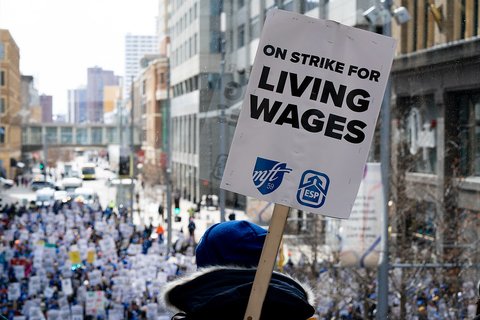
PRA has written much in the past about the Right’s attacks on the most vulnerable groups of working people: women, people of color, LGBTQ people. We’ve identified several ways that the Corporate Right is partnering with the Christian Right and using its rhetoric to transform our democratic infrastructure and institutions. Even secular free-market think tanks and self-described non-religious libertarian billionaires are dabbling in this moralistic, Christianized messaging. Our research on these trends has helped to inform some of the most effective recent campaigns for economic justice, including: the fight for domestic workers’ rights, the fight for paid family leave laws, and the fight for fair wages for restaurant workers.

Religion Dispatches
What would “a tranny hustler,” peeking through a rip in the stocking of space-time, think of our world 40 years later? What will the next Consciousness Revolution look like?
Article
Religion Dispatches
According to a pathbreaking new book, Wal-Mart’s success in reframing traditional gender roles, bending the curricula of business schools, and sanctifying working-class consumer capitalism, help explain the connections between conservative politics, the market economy, and family values.
Article
Religion Dispatches
When rapacious quasi-capitalists start acting like there is no tomorrow, that’s when the economy hits the fan.
Article
Public Eye
Abby Scher details how the Right’s fight over the Employee Free Choice Act shows the Right’s strength even after an electoral defeat.
Article
Religion Dispatches
It’s difficult to believe that Newt’s role as critic of Obama’s foreign policy has as much to do with patriotism as with raw political ambition.
Article
Religion Dispatches
Obama ran on a platform of change, but he’s been unwilling to mess with the status quo on either war or the economy. As the crisis deepens, the language of psychology trumps the language of faith, even on Main Street.
Article
Religion Dispatches
The language of faith has been so debased in the current economy, that it no longer seems worthy of credit. The current president, and his allegedly Palin-fueled base, have a lot to do with that.
Article
Public Eye
The 2008 ballot initiatives could impact races up and down the ballot including the Presidential campaign, by elevating an issue and shaping the debate. Dissatisfied voters in particular may see ballot initiatives as a means to fill the leadership vacuum
Article
Political Research Associates
Privatizing the Common Wealth
The Pioneer Institute has engaged in a well-funded, well-connected effort to influence the direction of politics in Massachusetts, a historically liberal state that has elected Republican governors and adopted many right-wing policies.
Report
Public Eye
The Erosion of U.S. Democracy
Right-wing leaders often appropriate progressive themes by calling for rule by “the people,” equal opportunity, and “equality” feminism.
Article