science and religion

Religion Dispatches
As National Day of Unplugging looms (it begins a week from today) I hope we all can agree that taking time away from the frenzy of everyday life is a good thing. And pausing to reflect on the role of technology in our lives is important at a time when social technologies in particular are becoming increasingly integrated into daily life with effects that we are just beginning to describe and understand. But I do have to wonder if the keen, even if not hostile, focus on technology as such misses the phenomenological, relational, and spiritual mark just a bit.
Article
Religion Dispatches
If you haven’t heard of Jonathan Haidt yet, you probably will soon. The social psychologist from the University of Virginia is making quite a media splash. Most recently, he set off a small media storm by calling out his fellow psychologists for unacknowledged liberal bias. …
Article
Religion Dispatches
The Confession app relies on a certain level of theological understanding, liturgical compliance, and spiritual will that we might be hard-pressed to find in even a relatively sophisticated believer. This is not entirely a failure of catechism or human will, I suspect. Rather, it is a continuation of what I have seen as a failure of mainline Catholic and Protestant pilgrims into new digital territories to grasp the social nature of new media.
Article
Religion Dispatches
The church, in its ignorance of and hostility to evolution, is passing up one of its greatest opportunities to apprehend the very God it claims to represent. This irony is due to a terrible case of what may be called “small-god-ism” and is, unfortunately, encouraged by much popular theology. This theology makes claims about scripture and church practice that reduce God to a cheerleader, or a cosmic vending machine, or some domesticated and pale image of our own confused selves.
Article
Religion Dispatches
Most physicians trained in modern scientific medicine are quite skeptical of complementary and alternative medicine and other spirituality-based healing practices, but contemporary research points increasingly to what we might call the deep semiotics of health. It seems, minimally, that hope helps to heal. And ritualized hope in groups heals more effectively.
Article
Religion Dispatches
While I might have some kind of God-experience, unlike testing aspirin, I can’t easily carry out my God-experience simultaneously on statistically significant large numbers of people, write up the experience, repeat it, compare the same number of people at the same time who don’t believe in God, but are otherwise similar, see if they have the same experience, and then have someone repeat my experiment and see if they get the same results. This method is what science is supposed to be about; this is scientific proof, this is what scientists believe in. But, says Jonah Lehrer, it’s not that simple. He describes what he calls ‘the decline effect’: many experimental results that are strikingly positive and statistically significant are not replicable.
Article
Religion Dispatches
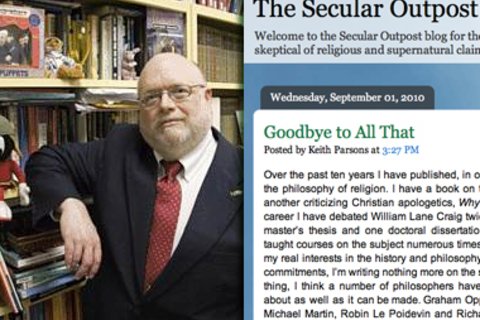
Philosopher of Religion Keith Parsons hung up his hat a few months ago, after announcing that he believed the “case for theism” to be a fraud: “Theistic philosophers and apologists are almost painfully earnest and honest… I just cannot take their arguments seriously anymore.” It’s rare for a philosopher to renounce his or her own specialty—but Parsons’ rejection speaks to a broader dilemma.
Article
Religion Dispatches
Although medicine should stay in the business of being evidence-based, says Harvard historian of science Anne Harrington, other healing communities don’t necessarily need to follow that model. There’s a place for data, but you need to know what data can’t tell you.
Article
Religion Dispatches
Most principled atheists do not go beyond simple denial. They refuse to go further, to seriously question the ground beneath their feet. And, by holding on, consciously or not, to their unjustified assumptions, they end up rejecting far too little.
Article