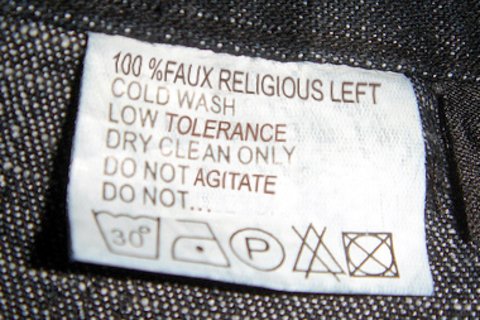
Mark Silk’s recent analysis of the rift between the “prophets” and the “priests” of the left hinges on the assumption that reaching out to centrist evangelicals will help Democrats. But will it?
President Obama got his campaign slogan from Cesar Chavez, but on this 16th anniversary of the great labor leader’s death we still have no national holiday to commemorate his legacy.
A public row threatens to break out between the DC-based “Religious Industrial Complex,” which seeks new Democratic voters, and a small group of rabble-rousers who claim that they’ve compromised their progressive souls in reaching out to religious conservatives. How did it come to this?
When we take the approach that “all are sinners,” we confuse big-time criminality with small-time folly. This moral obfuscation allows the far greater misfeasance of corporate creditors to get airbrushed out of the picture.
While the mainstream press has been eager to proclaim the demise of the Episcopal Church, a brief tour of church history reveals that 100,000 Conservative Anglicans defecting from the 80 million-member Communion is nothing more than a case of the spiritual sniffles.
We have failed, as a society—for millennia—to ascribe worth to the one sustaining gift of the universe that we touch and feel every day: the earth itself. Rex Weyler, co-founder of Greenpeace, has an Earth Day message about ecology, community, and spirit.
Capitalizing on the Muhammad cartoon riots and Western anxieties over the persecution of Muslims, the UN Human Rights Council passed a resolution urging member states to prosecute for “religious defamation.” Problem is, those likely to suffer most are religious minorities.
A recent New Republic book review argued that science and religion cannot be reconciled. In response, biologist Arri Eisen suggests that we acknowledge the ‘pink elephant’—the thorny questions that arise when religion and science meet—and use it as an opportunity to teach and learn about the conflicting perspectives.