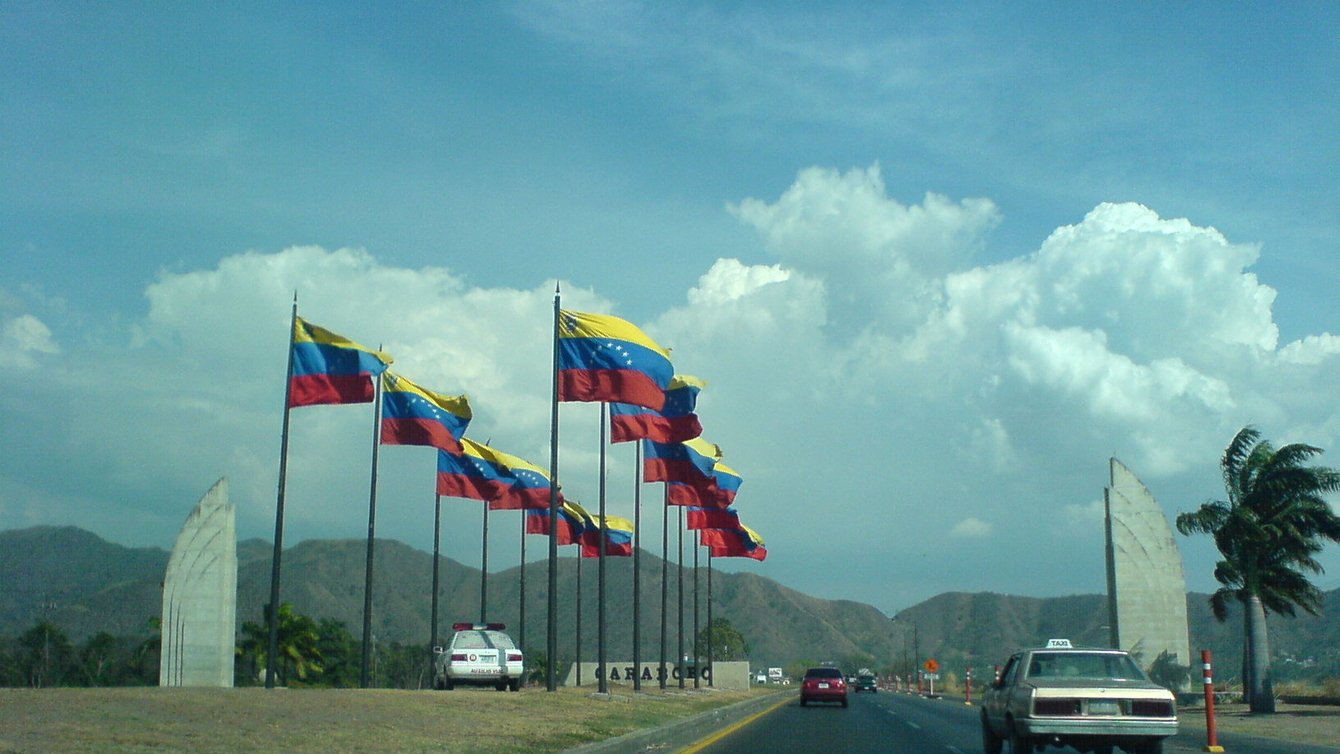
On January 3, 2026, the Trump administration bombed Venezuela and abducted President Nicolás Maduro and his wife, Cilia Flores, taking them to New York to face “narcoterrorism” charges. The escalation followed several months of U.S. military strikes on boats in the Caribbean and Pacific oceans under the pretenses of a “War on Drugs” that has killed more than 130 people (as of this writing on February 18); a military blockade; and the seizure of Venezuelan oil tankers, along with threats to take over the country’s oil industry.
The following article is drawn from a season 5 episode of PRA’s podcast, Inform Your Resistance. Host Koki Mendis talks to PRA Principal Research Advisor Steven Gardiner about the attack on Venezuela, how this violent aggression resonates with the Short for Make America Great Again, the slogan of Donald Trump’s 2016 presidential campaign. Learn more base, and its implications for the Trump administration’s consolidation of power [Footnote 1] at a time of growing domestic opposition to ICE enforcement. This conversation was recorded on January 15, 2026, and the interview excerpt has been edited for clarity and length. Readers can listen to the full episode here.
What does the attack on Venezuela and the kidnapping of Nicolás Maduro, taken seemingly unilaterally by the Trump cabinet, signal about the evolution of U.S. democratic structures in Trump’s second term?
Steven Gardiner: One, in some ways, it’s ordinary U.S. imperialism along the lines of concentrating power for foreign policy and military action overseas in the office of the President. Historically, Congress has not been happy about this [bypassing of democratic oversight], even when the president’s own party held the majority. But this case extends that, as Congress was not even notified beforehand.[Footnote 2] Two, this was a masterfully planned and executed military action that has no cogent reason for having been done—not even in standard imperialist worldviews, except maybe one.
There are four different justifications coming from various parts of the White House infrastructure, none of which add up.
First is the goal of regime change. Maduro was not a charismatic leader and taking him out of the picture does not change Venezuela’s regime. But Marco Rubio, who is of Cuban descent, has a lifelong animus towards Cuba’s current regime and wants to change it. Since Venezuela is a primary ally of Cuba in the region, he would like to undermine Venezuela and get them to stop supporting Cuba. Most of the other people don’t care about that very much.
Second, Stephen Miller wants to escalate belligerence in the world to say we’re at war or in a warlike situation with Venezuela or otherwise, in order to invoke the Alien Enemies Act and use it to deport people with even less due process [than now].[Footnote 3] This doesn’t seem to be happening, but it’s being teased.
Third, oil is the reason that Trump finds acceptable, with the hope of making a big profit. That is unrealistic. It will take billions of dollars of investment and it may take 10 years for it to be profitable according to experts. But there is a way to profit by subsidizing more development by U.S. companies and security and infrastructure in Venezuela, siphoning money from U.S. taxpayers and giving it to U.S. corporations. That is probably the only way there will be quick, big profits from this.
This belligerence and brutality is also happening domestically in the U.S., in Minneapolis, and previously in Chicago, DC, Los Angeles, and anywhere that happens to be in political opposition to the president.
The fourth and last reason has directly to do with democracy, in showing that the U.S. is a belligerent power [and saying] You cannot mess with us. If we don’t like you, we will come and kill you or kidnap you. This is truly corrosive to democracy—and the only one of these four justifications that is actually happening. It’s an on-the-ground reality that runs roughshod over [democratic procedures like] congressional oversight and review by the courts. If a U.S. court says, we don’t have jurisdiction and would send him back to Venezuela for trial or to the International Criminal Court, the Trump administration could say that liberal judges—even ones he appointed—cannot be trusted. And we don’t need these damn courts anyway.
This belligerence and brutality is also happening domestically in the U.S., in Minneapolis, and previously in Chicago, DC, Los Angeles, and anywhere that happens to be in political opposition to the president, like the Maduro administration. The result is gratuitous threats that may not be gratuitous against Mexico, Cuba, Greenland, and apparently all of NATO.
That’s an important parallel between the belligerence inside U.S. borders and outside them. It’s also telling that the four stated reasons do not include concern over fentanyl trafficking through Venezuela, which is the administration’s standard—but false—talking point to its MAGA audience.
Gardiner: Yes, though some people in the Justice Department would like to make fentanyl cases related to Venezuela, the underlying reality is hardly contested: Venezuela is a negligible node for shipping or producing fentanyl of any kind. Even with cocaine, it’s a small-time player compared to Colombia or with fentanyl, China and Mexico. This idea is made up—but that doesn’t mean there can’t be some brutality and spectacle.
It’s a demonstration that we don’t care about due process. We care about spectacular brutality and intimidation.
We’ve already seen that with the blatant murders of people claimed by the Trump administration to be drug traffickers in international waters in the Caribbean and the Pacific. Of course, there’s no provision in U.S. or international law for summary execution of drug traffickers, even if they could prove that’s what they were—and no proof has been offered. So, again it’s a demonstration that we don’t care about due process. We care about spectacular brutality and intimidation.
The attack on Venezuela, these shows of brutality, similar threats of intervention in Iran and potential intervention in Cuba: How does this resonate with America First,[Footnote 4] the purportedly non-interventionist movement within the MAGA coalition?
Gardiner: You would think it would cause great consternation and conflict. In fact, that’s been minimal and mostly the pushback has been from people outside of the regime. Initial polling suggests that the base is okay with it. People like Steve Bannon are not thrilled about the rhetoric around Iran and don’t want to get involved. [Ed note: On February 28, U.S. and Israeli officials began a war on Iran with joint military strikes that have killed 1,230 people in Iran (as of March 5). The escalating war has already expanded to 11 countries across the region.] But even Bannon has referred to the Venezuela attack as, well, this isn’t war, this is effective action. The MAGAverse is framing this as Donald Trump simply imposing his will in his quick and violent, testosterone-fueled way. It’s a U.S. foreign policy where the entire Western hemisphere is part of the necessary backyard, the Monroe/“Donroe” doctrine of this is ours, leave it alone.[Footnote 5]
The MAGAverse is framing this as Donald Trump simply imposing his will in his quick and violent, testosterone-fueled way.
There’s some splitting down the line. A few people like Tucker Carlson have questioned why the administration was doing this, raising concerns about negative repercussions. But if the real reason is showing a willingness to beat people up and kill them because we don’t like what they’re doing or they won’t bend the knee—that’s a reason. It’s an old-school imperialist reason.
What are the implications of this show of hypermasculinity—of “might makes right,” or the impunity to violate international and domestic law—for electoral politics and the 2026 midterm elections?
Gardiner: It depends on how well the administration can sell [the idea] that what it is doing works. This is the attraction of fascistic or authoritarian forms for some people who believe they are more efficient than democracy: that if you give someone all the power and just let them decide and enforce [their decisions] with violence against anyone who dissents, you’ll get things done.
There’s no evidence in the Trump administration to back these claims [of efficient action]. But in this situation, a performative, hypermasculinist way of framing politics[Footnote 6] will have some impact in the MAGAverse, and possibly beyond, if people are feeling afraid and Trump can sell [the idea that] it’s not his fault, it’s the fault of those who won’t go along with what is right for America.
Will this work? It depends on how this chaos impacts the economy and the lives of people far from where the violence is being enacted most acutely. Venezuela and the Caribbean are much closer in many Americans’ minds than Gaza or Somalia. But Minneapolis and Chicago are in our midst.