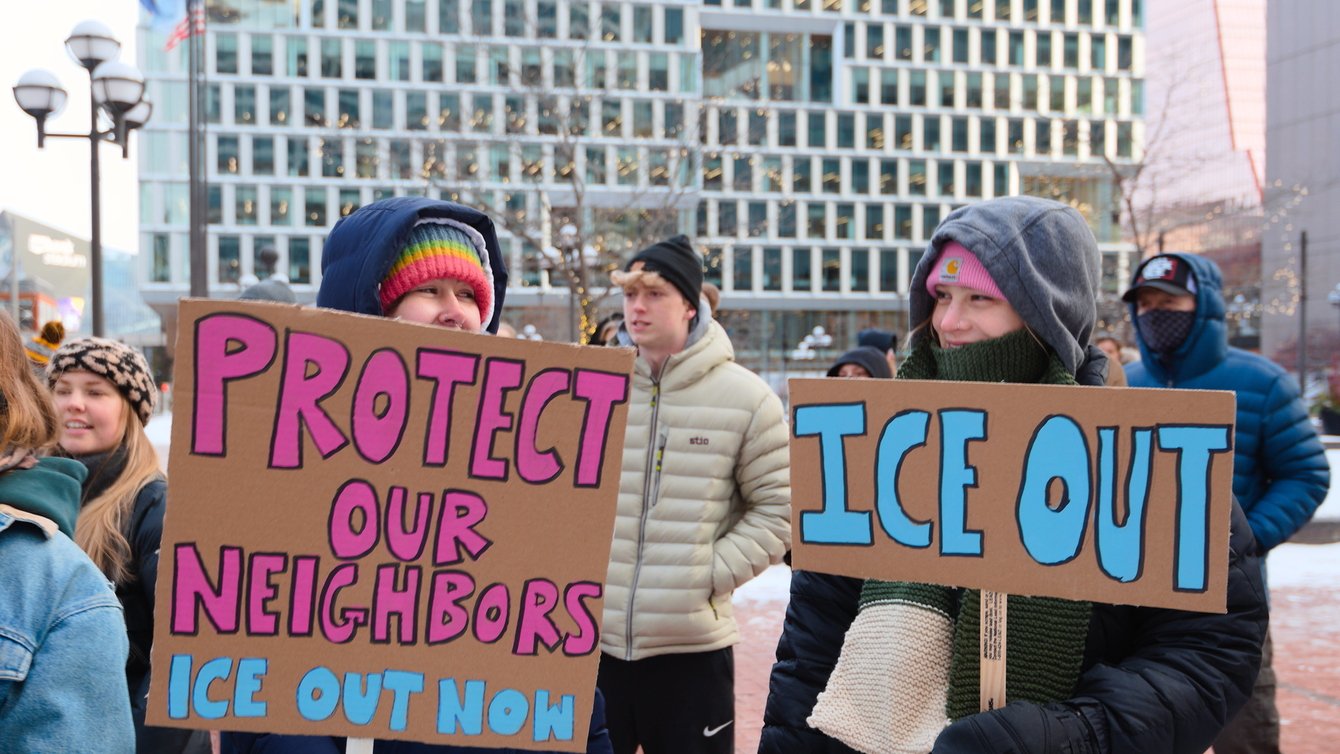
With ICE agents kidnapping thousands of people and executing people in broad daylight, the Trump administration’s A form of top-down political system that concentrates state power in the hands of a single leader and/or group of close allies. Learn more has been on full display for all to see. But so is the power of everyday people who are organizing everywhere to defend their immigrant neighbors and their communities: by grinding business-as-usual to a halt, they have shown the entire country and the world what it takes to stand up.
In this article, drawn from a season 5 episode of PRA’s podcast, Inform Your Resistance, guest host and PRA Senior Research Analyst Ben Lorber talks with his colleagues Annie Wilkinson, Ethan Fauré, and Steven Gardiner about ICE’s deadly crackdown in Minneapolis and city residents’ powerful resistance. To make sense of the moment, they discuss what brought us here: the decades-long advance of today’s anti-immigrant movement; the authoritarian playbook’s strategies of lawfare, Repression occurs when public or private institutions—such as law enforcement agencies or vigilante groups—use arrest, physical coercion, or violence to subjugate a specific group. Learn more , and fearmongering; and what the resistance in Minneapolis can teach us as we sharpen our strategies to block the Right and build a better future.
Their conversation was recorded on January 30, 2026, and the following excerpts have been condensed and edited for clarity. Readers can listen to the full episode here.
Lorber: Let’s start by looking at the strength of this resistance. Shortly after Alex Pretti was murdered, I wrote about the online Right’s shock over grassroots mobilizing in Minneapolis, after a right-wing provocateur posted screenshots from a public, unvetted Signal chat showing neighbors organizing mutual aid and ICE watching.
Very quickly, the Right had a unified chorus of fear: The Left is infinitely more organized than we are. They are adept at magnifying the threat by painting a conspiratorial portrait of an all-powerful, hidden enemy. But I also detected an envy of the Left’s ideas, vision, organizing, and deep rootedness in communities—of the solidarity that allows neighbors to show up for each other consistently.
What’s happening in Minneapolis? What inspiring lessons can we learn from it?
Wilkinson: Minnesotans are showing us the power of organized communities and how powerful we are when we come together. Folks on the ground have been talking about how, even in a city with a painful history of racial injustice and racial and class segregation, everyone is coming together united in defense of one another. They’re really showing us what the power of an organized community that is invested in defending each other and defending their neighbors looks like.
One story that someone shared with me from the ground: the Whipple Federal Building [ICE’s base of operations in Minneapolis] has been the center of many protests. After the public execution of Renee Good, people from all walks of life came out to protest the federal government’s overreach of power and excessive force. White suburbanites were coming out to Whipple to protest [violence against] and stand with their immigrant Black and Brown neighbors. That is a powerful symbol of what we can do when we are united in community.
That doesn’t mean these occupations haven’t caused incredible pain and loss that we have to grieve. But it has also united us. It has galvanized us. If we’re paying attention, we’ll also see the immensity of our power.
“If we’re paying attention, we’ll see the immensity of our power.”
I’ve also been thinking about the strategy involved. At PRA, we spend a lot of time thinking about how to effectively counter authoritarian movements. One of the orientations that we discuss is Block and Build: how to block authoritarian movements and how to build multiracial democratic movements.
Sometimes, when we build, we are also blocking. What we see coming out of Minneapolis, Chicago, and other places around the country that are occupied by federal forces is that the networks of care that communities are building is what is going to effectively block authoritarian consolidation.
That’s what the Right is taking away from this. It’s what we should take away from it too.
Folks on the ground in Minneapolis have said they’re drawing upon networks that were built in summer 2020 during the George Floyd uprising, and before that, in COVID mutual aid. What Block and Build lessons can we learn from Minneapolis?
Gardiner: People are not only protesting—they are helping each other by identifying threats, delivering mutual aid, providing food and shelter, coordinating, and doing it spontaneously with little organized leadership through networks. It’s contrary to the myth that says government is the least efficient way to do things, business is the most, and people can’t do anything for themselves. The lesson is that when the stakes are high and people see an ethical obligation to their neighbors, they act spontaneously in solidarity, even under terrible conditions, and it’s incredibly efficient.
That is untapped power. Another lesson for Block and Build is understanding that if you’re going to mobilize, people are going to mobilize themselves.
At PRA, much of our work on the Block side is to identify threats—like conspiracy mongering and infiltration—and right-size those threats for people. This is neighbors helping neighbors. It’s a matter of practical concern that the Department of Justice and Department of Homeland Security don’t like it, but it’s not a political, legal, or moral concern.
Lorber: Thanks for this point. The Right is fearmongering [around the idea] that helping our neighbors is somehow “domestic terrorism.” It’s important not to let that demobilize us. What we’re doing is completely legal and in accord with moral principles.
Wilkinson: It’s worth naming what the federal government wants to construe as “conspiracy” or “domestic terrorism.” It’s things like a bookstore owner telling the story of what he witnessed, an adult store becoming a donation and distribution center, and full-time tow truck companies donating their services to pick up vehicles that ICE abandoned. [It’s] social workers stepping up to take in children who’ve come home to find that both of their parents have been disappeared, and working parents taking shifts outside schools to protect their neighbors’ children and teachers in their communities.
This is what DHS wants to call conspiratorial or domestic terrorism. It’s obviously ludicrous. The resistance looks like everyday people who are coming together to meet basic needs and take care of one another. It’s every bit as terrifying as the Right seems to think it is.
“The resistance looks like everyday people who are coming together to meet basic needs and take care of one another. It’s every bit as terrifying as the Right seems to think it is.”
The anti-immigrant movement was once more marginal on the Right but now they are setting the agenda. Who and what has led us to this moment? How does their agenda draw from deep roots in U.S. history that are manifesting in terrifying ways now?
Fauré: The origins of the U.S. Border Patrol can be found in the 1920s when the U.S. had arguably its most explicitly racist immigration policy. There were national quotas admitting mostly people of European descent, with eugenicists testifying before Congress and informing laws. That’s the path that the anti-immigrant movement is trying to recreate. That’s the immigration system they want.
The contemporary anti-immigrant movement emerged from organizations that were founded or nurtured by the White nationalist John Tanton in the 1970s and 1980s. These include the two most notable ones, the Federation for American Immigration Reform and the Center for Immigration Studies.
They’ve had some success, but [early on] they faced opposition in the 1980s from Ronald Reagan. Reagan signed a law that provided legal status to some three million people. That massive defeat reinvigorated their efforts to make the immigration system more restrictive. Ultimately, they succeeded in rewriting the legal immigration system in the 1990s with bills signed into law by President Clinton. That created the modern architecture for the mass deportation machine and the 287(g) program that has exploded recently—and which was supercharged by the national security state after 9/11.
The last 20 years is really where the anti-immigrant movement has gained not only policy influence, but a cultural influence with the Short for Make America Great Again, the slogan of Donald Trump’s 2016 presidential campaign. Learn more movement’s rise. The Trump administration’s first campaign is where you see the personnel overlaps. Stephen Miller, for example, was working with these groups when he worked in Congress with Jeff Sessions and Minnesota Representative Michelle Bachmann before that. The professionalized nativist class of the 21st century has emerged from this cultural firmament and is now in the highest echelons of power.
Perversely, now these same groups claim they’re presenting a moderate approach to immigration enforcement. You know, it’s not shooting citizens on the streets. It’s saying, we want work site enforcement, or we want to eliminate the refugee resettlement program and these other things that, compared to outright violence in the streets, can appear moderate.
In this moment, I want to make sure we don’t lose sight of this: the ideas and policy prescriptions of the anti-immigrant movement are no less dangerous and violent than they ever have been. It’s the same agenda through-and-through, whether it’s those who are going beyond the pale while implementing that agenda or lobbyists and think tanks that would have us believe they are acting with decorum. It’s just variations on how they approach so-called “attrition through enforcement.”
“The ideas and policy prescriptions of the anti-immigrant movement are no less dangerous and violent than they ever have been.”
Gardiner: I’d like to pivot on that a bit. […] The enforcement policies are part of the issue here. There is also another agenda for ICE’s spectacular brutality, which is to desensitize people to the use of force in creating a more powerful federal government with its own secret-ish security force that can commit violence on citizens. It can accuse anyone in opposition of being a terrorist and kill them.
This is the kind of counterinsurgency warfare that’s been directed against Black and Indigenous people in this country. And now it’s spreading.
Wilkinson: Exactly. Steven’s comments allow us to tease apart two overlapping, but distinct political projects that we need to understand are behind the federal occupation of U.S. cities by DHS.
The first is the White nationalist project that undergirds the anti-immigration movement. It seeks to maintain Both a system of beliefs that holds that White people are intrinsically superior and a system of institutional arrangements that favors White people as a group. Learn more and sees immigration and people of color as threats to that vision that need to be subordinated or removed. It has been present in different ways throughout U.S. history, and it’s the impetus behind immigration enforcement today.
The other project is an authoritarian consolidation of power. This is being done by scapegoating immigrants and trans people […] using methods found in authoritarian regimes, like militarized security forces under the control of a concentrated executive.
How can we understand these threats and realize where our power lies in resisting it?
Wilkinson: What they’re doing is a standard authoritarian maneuver to chill dissent and attempt to eliminate resistance to their efforts to consolidate power.
A key example is the federal case against the Broadview six, who are facing fabricated charges of conspiracy to impede. The prosecution is having a hard time getting the charges to stick because they aren’t providing any evidence of an actual conspiracy. And that’s because the case isn’t about facts. It’s a blatant attempt to intimidate through the criminalization of protest and persecution of high-profile figures, to set a nationwide precedent. Authoritarians cannot exert total control over a population. So, they weaponize fear and hope we’ll do their work for them. They terrorize a few so that we police ourselves into silence. This only works if we don’t see through it. And I think people are seeing through it, led by those who have faced criminalization and repression in this country for a long time, and those who have this experience abroad.
“[Authoritarians] weaponize fear and hope we’ll do their work for them. They terrorize a few so that we police ourselves into silence. This only works if we don’t see through it.”
Greg Bovino has been an emblem of ICE’s authoritarian crackdown, and he acts the part. But Tom Homan has been a core part of the anti-immigrant movement. How does Homan’s rise show the arc of the movement and where it plans to go in the coming months?
Fauré: Homan is a lifelong law enforcement official. His current position exemplifies the anti-immigrant movement’s growing influence over the last 15 years. Homan was a high-ranking official during the Obama administration and was considered a mainstream voice on enforcement matters. He’s been more radicalized publicly in the last decade as he’s worked more closely with anti-immigrant groups and served the first Trump administration as acting ICE director.
So, I’m troubled by the presentation of Homan as a “moderate” voice coming into Minnesota. He has said things like, I want federal agents to attempt to deescalate things. I don’t want them interacting with protesters. That’s a soft An attitude toward social identities that can be mobilized to justify discrimination, state/vigilante violence, and exploitation. Learn more of low expectations, if that’s the baseline. We can’t allow this.
We’ve talked about the concrete goals of the anti-immigrant movement and authoritarian consolidation, which attempts to demobilize resistance by projecting fear. What have you learned from work on the ground about how that tactic might continue to be deployed, and how we can remain brave and resilient in the face of it?
Wilkinson: At PRA, we talk about making violence backfire and that’s what we’re seeing [on the ground]. Every time a federal agent murders a legal observer or an immigrant at a traffic stop, more people come out of their homes to protest, sign up for trainings to become rapid responders or engage in mutual aid to support their community. That is what gives me hope.
Gardiner: Everyone is stepping up and doing everything they can. I haven’t seen this level of activity and understanding that what they’re doing is supporting a movement.
If there’s anything other than an attempt to increase the authoritarian concentration of power in the administration, I will be shocked.
And if there is anything less than a full-throttled response from people on the ground, wherever it hits, I will also be shocked. So, hope is built into how I’m looking at this.
Fauré: Midwest solidarity is a beautiful and powerful thing, and I’m astoundingly inspired by Midwest solidarity in the middle of January against authoritarian forces. It surprised me and, in that surprise, I feel tremendous hope too. Also, it’s gone somewhat unnoticed, but that solidarity in organizing led to the first general strike we’ve seen in decades.
“We could be running away, but we’re not. People are running towards danger. They’re running towards their neighbors and towards solidarity.”
Wilkinson: I’m reminded of a phrase in a piece that Kelly Hayes wrote after being involved in organizing for several months in Chicago.
We could be running away, but we’re not. People are running towards danger. They’re running towards their neighbors and towards solidarity. The federal government’s using tactics of division that are not working. That is the thing that keeps me going, having seen this firsthand in Chicago during Operation Midway Blitz. […] Folks are running towards danger for each other, with each other.
Lorber: I really love that idea of running toward danger. […] I was thinking that another way to read it is: don’t be afraid alone. Don’t withdraw into isolation in your fear. Recognizing that we’re all in this together, and being afraid together, we can, in some sense, transcend our fear.