Journalism has seen a profound shift since Trump’s arrival on the political scene in 2015. Reporters are scrambling to keep up with an accelerating news cycle and esoteric fascist formations that have gained undue relevance for their influence on those in power. As investigative journalists continue to uncover important stories from this country’s unseemly political underbelly, U.S. and global publications have also relied on the research of rank-and-file antifascist activists who seek to warn the public and hold White nationalists and neonazis accountable. This research has been the start of many articles on the Far Right, by serving as background for the standard journalistic process of reporting, verification, and storytelling.
Christopher Mathias is one such journalist whose work has resulted in hundreds of revelations of the Generically used to describe factions of right-wing politics that are outside of and often critical of traditional conservatism. Learn more characters now influencing U.S. life and politics. With his first book, Mathias decided to turn his attention to the antifascists themselves. To Catch a Fascist: The Fight to Expose the Radical Right (Atria Books, 2026) looks at militant antifascist efforts to infiltrate and ultimately expose fascists in what is often called “doxing”: the revelation of personal information as a part of a campaign for accountability. Mathias tells a fast-paced story of espionage and insurgency as he chronicles the undercover activists behind the headlines about groups like Patriot Front. In doing so, Mathias also tells the story of a movement that has grown alongside the Far Right and now acts as a defensive network maligned by Trump and his allies, working to keep communities safe amidst a climate of extraordinary fear and violence.
PRA spoke with Mathias about his new book on antifascist research and activism, and where that energy is going in Trump’s second term.
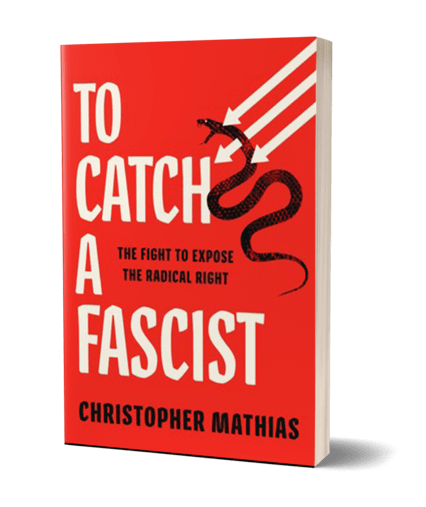
To Catch a Fascist: The Fight to Expose the Radical Right (Atria Books, 2026)
Shane Burley: Instead of focusing only on the rise of the Far Right, your book looks specifically at the antifascist researchers who work to expose far-right groups and mobilize the community against them. What made you want to focus on that?
Christopher Mathias: There have been many good books about the Far Right. But as I was thinking about my own career as a journalist, I realized that so many of my biggest stories were actually based on antifascist research. I started to think about how antifascist intelligence gathering, research, and espionage was the hidden hand behind thousands of news stories during the Trump era. It shapes our understanding of this political moment. And the people who had gathered that intelligence and done that research often didn’t get their due. So, it felt important to me to write a book about the Far Right from the perspective of those who were fighting them.
At the end of the day, it’s also just a good story. It’s a good narrative of people going undercover, as a vehicle to explain militant antifascism and make it more palatable.
“Antifascist intelligence gathering, research, and espionage was the hidden hand behind thousands of news stories during the Trump era.”
The book centers the story of an activist who goes undercover to expose the neonazi group, Patriot Front. What was so compelling about their experience?
When I set out to write this book, it felt incredibly daunting because I was determined to find a narrative that could glue the book together. I started by compiling a database of about 1,000 doxes that antifascists had published over the past decade. I did that to find the most compelling story that could carry the book.
I was starting to realize how many members of Patriot Front have been doxed. And after 2021, when I was having conversations with anonymous antifascists across the country, I would always end by asking them about the most compelling or interesting story they had heard about antifascist work.
Someone from [an antifascist group] told me about someone who had gone undercover with the Patriot Front. I ended up writing a long letter to Vincent, his pseudonym in the book, explaining why I thought his story was so important to tell and emphasizing that I knew it’d be risky to talk to me, but I’d take necessary precautions. He agreed and I went to Seattle to meet him.
From there, it was a painstaking process of piecing together a narrative from the data, and the photos and videos he had gathered. His story was dramatic and about an in-person infiltration, but he’s also a very thoughtful, serious guy. It seemed fitting to have the story be about someone who infiltrates a Nazi group that is still around because, as much as the book is a story about antifascism, it’s also a narrative about rising A form of far-right populist ultra-nationalism that celebrates the nation or the race as transcending all other loyalties. Learn more in the U.S.
“As much as the book is a story about antifascism, it’s also a narrative about rising fascism in the U.S.”
In the last few years, some have questioned whether exposing the Far Right is becoming less effective. It’s hard to show people the significance of a person’s fascist politics when the president of the United States says remarkably similar things. Do you think that these revelations have had diminishing returns?
This touches on an existential question for me right now with journalism. I’m trying to figure out what this means for my beat, and what I’ve been writing about for so long. How do you hold a movement accountable that doesn’t care about accountability?
There are definitely stories of these doxes losing their efficacy. One story I tell in the book is about Judd Blevins, who was doxed for having been a regional leader of Identity Evropa and for marching in Charlottesville. Nevertheless, he runs for city council in Enid, Oklahoma and wins, even though the local news had verified antifascist research. His supporters either thought it was a lie or claimed that Charlottesville was not a fascist rally, and he evaded questions by calling the people who asked them radical leftists.
The coda to that story is that a small, determined group of progressive activists in Enid banded together to get a recall election. It’s remarkable. In one of the reddest states’ reddest cities, they maintained what is basically the lowest of barriers to holding office, which is that you can’t be a Nazi. Blevins ultimately lost the recall election, but still got 40 percent of the vote.
“How do you hold a movement accountable that doesn’t care about accountability?”
I’ve heard antifascists dealing with this dilemma of publishing a story about someone and, whereas maybe seven or eight years ago that person would have been fired right away or pushed out, now that’s not the case. There is also the sheer “groyperfication” of the GOP where you have someone like James Fishback in Florida. At this point, who is joining the GOP below the age of 30 who isn’t a groyper?
That said, the work is still really important. In the book, I describe doxing’s effectiveness as twofold: alerting your neighbors that there’s a Nazi nearby, and creating a social cost to deter people from joining Nazi groups. Even if the ability to create that social cost is dwindling at the moment, it’s still important to create it and at the very least alert people to the danger.
Antifa has been a boogeyman for the Right for many years now, which has led to profound hyperbole, from labeling it a “terrorist” movement to shifting state resources away from monitoring supremacist threats and toward repressing the Left. What are the effects of this A way of portraying a person or group as malevolent, sinful, or evil; often a precursor to scapegoating and conspiracism. Learn more and criminalization of antifascism?
CM: I’ve grown accustomed over the last ten years to things being simultaneously farcical and very dangerous, and that’s how I view the Trump administration’s terror designation.
Legally, it’s farcical. There’s no domestic terror statute. But the declaration is the Trump administration announcing that it’s open season on the Left. They are signaling to law enforcement, prosecutors, and vigilantes that they can do anything they want once someone is labeled as antifa.
It’s striking that in September 2025, antifa was labeled a domestic terrorist organization. Then after the murders of Alex Pretti and Renee Good, the administration retroactively labeled them “domestic terrorists” as justification [for their deaths].
So, it’s not an exaggeration to say that this administration thinks that if they label someone antifa, that person is effectively a domestic terrorist, which means they can be killed, hurt, prosecuted, and so on. And trials like the recent Prairieland case, where activists were prosecuted for violent acts they likely didn’t commit, are frightening.
“This administration thinks that if they label someone antifa, that person is effectively a domestic terrorist, which means they can be killed, hurt, prosecuted, and so on.”
That makes me think a bit about where the antifascist movement is today at a point when the Far Right has power in the government. As someone who has covered antifascism for years, where are you seeing it heading today?
Even while Repression occurs when public or private institutions—such as law enforcement agencies or vigilante groups—use arrest, physical coercion, or violence to subjugate a specific group. Learn more is happening, resistance to ICE is where antifascism is headed. It’s often being done by people who don’t traditionally label themselves antifa. The parallels between the uprisings in Minneapolis and the antifa street mobilizations in 2017–2019 are striking. What are they doing in Minneapolis? They are monitoring, surveying, and warning the community about ICE. It’s the antifascist “we go where they go” idea. They’re pressuring businesses and venues to not do business with ICE. That’s an age-old antifascist tactic.
There’s also direct confrontation and putting bodies on the line, combined with everyday mutual aid. It’s a beautiful incarnation of the axiom “we protect us” in action. The antifa boogeyman will lose its efficacy because these kinds of organic uprisings are happening among everyday people who might not consider themselves political but see the necessity of protecting their neighbors.