
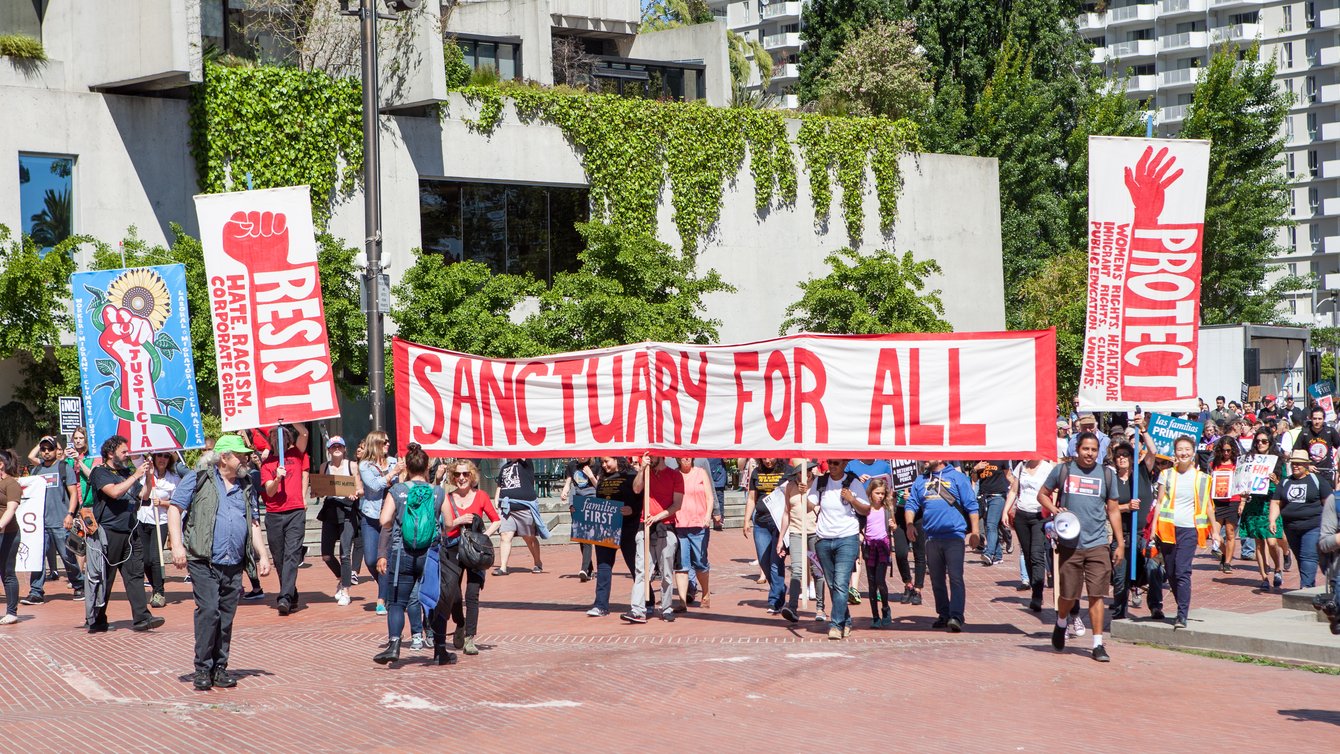
One target looms particularly large in Trump’s ongoing rhetorical and policy attacks on immigrant communities: sanctuary cities.
For over a decade, Trump, his administration officials, and Short for Make America Great Again, the slogan of Donald Trump’s 2016 presidential campaign. Learn more -aligned media have demonized sanctuary cities that limit the use of local resources to cooperate with federal immigration enforcement as lawless hotbeds of crime. These unproven characterizations were a primary justification for the federal government’s violent, militarized occupations in Los Angeles, Chicago, and Minneapolis-St. Paul, among others. Leaders in those cities rightfully say sanctuary policies build trust and a sense of security for immigrant communities, but that’s an incomplete picture.
In On the Side of ICE: Policing Immigrants in a Sanctuary State (NYU Press, 2025) anthropologist Peter Mancina details how sanctuary policies alone do not prevent local cooperation with federal immigration enforcement. The book’s novel approach uses body-camera footage to detail local police departments’ encounters with immigrants and federal agents in New Jersey, a supposed sanctuary state. Mancina’s analysis reveals how local police serve as a force multiplier by assisting immigration authorities voluntarily, even as sanctuary states claim to protect immigrants and A term used to describe organizations, movements, ideas, and policies that oppose immigrants and immigration. Learn more demagogues vilify their jurisdictions.
PRA spoke with Mancina in March about current sanctuary policies’ shortcomings, bearing witness to increasingly militarized enforcement in U.S. cities, and the consequences of expanding local cooperation agreements and body-camera use for police accountability efforts. This interview has been edited for length and clarity.

On the Side of ICE: Policing Immigrants in a Sanctuary State (NYU Press, 2025)
PRA: What questions were you exploring when you started working on the book and how, if at all, did it change your thinking on sanctuary policy?
Mancina: I’ve studied this for about 15 years. I started out doing participant observation, an anthropological method for researching a topic from within the communities you’re studying. I worked with police officers in San Francisco. I worked with an immigrant rights coalition that identifies problems in sanctuary policy. I worked in City Hall, in the office of a legislator who’s one of sanctuary policy’s bigger proponents.
The media describes sanctuary cities as places that protect immigrants from the federal government. Progressives claim that they slow down immigration enforcement. As an anthropologist, I saw how the policies were implemented; once in a while, there’d be incidents where local law enforcement cooperated with ICE. The policies have many exceptions that allow police and federal agencies to cooperate. So, my question in the book was: how does that happen in everyday life, when a researcher isn’t there—when police feel safe to do what they want, outside of the eyes of others?
“[Sanctuary] policies have many exceptions that allow police and federal agencies to cooperate.”
You describe your approach as “surveillant anthropology.” How does this approach complicate popular understandings of sanctuary policies and the relationships between local and federal law enforcement?
The way I approached this is new in anthropology. A cultural or political anthropologist usually goes into “the field” and is watching things, participating. I called it surveillant anthropology because I didn’t do that. I examined state surveillance techniques and technologies to remotely watch what police do. I used New Jersey’s public records laws to request body-cam footage after the fact and reviewed them all.
The public tends to think of body cams as supporting police transparency. This is particularly how they were presented and implemented under the Obama Administration. And Democrats, in calling for ICE reforms, have asked for body cams. [Ed note: The White House offered to expand the use of body cams during its negotiations with Democrats to fund and reopen DHS.] But law enforcement thinks of body cams as a tool for making arrests and securing evidence. Police love them because they can cover their backs when they’re accused of wrongdoing or trying to secure a conviction. In one of the book’s chapters, local police go to an ICE arrest, and the ICE officer asks the police if they’re filming the event. When the police officer says “yes,” the ICE agent says “good.” The implication being that they’re noting the person’s behavior, which could then be used against them in immigration court.
I’m watching police footage as a critic to understand the process. I found that police largely continue to help ICE while implementing sanctuary policies. ICE considers them force multipliers, or cooperative auxiliary partners, even when they comply with sanctuary laws.
“[Sanctuary policies] have been ineffective at curbing police assistance to ICE. In the end, immigrants in sanctuary cities are still getting targeted by police. “
[Former Secretary of Homeland Security] Kristi Noem recently presented data to the House Judiciary Committee claiming it showed that sanctuary cities obstruct immigration enforcement. The number she gave was nearly 18,000 declined detainers in 2025. But according to the Transactional Records Access Clearinghouse at Syracuse University, if a sheriff has a policy to cooperate with every detainer, ICE only shows up 14 percent of the time to arrest people. So if these sanctuary jurisdictions actually said, “yeah, we’ll hold these people for you,” only 14 percent of the time would ICE actually show up to those local jails. That’s just over 2,500 people that ICE failed to pick up in sanctuary jurisdictions. Whereas DHS previously said that total U.S. immigration [deportations] in 2025 numbered around 600,000.
It’s clear that these policies and their effects have primarily been political, not operational. They have been ineffective at curbing police assistance to ICE. In the end, immigrants in sanctuary cities are still getting targeted by police.
Research shows that sanctuary policies have effects, but they’re not what politicians and the public have assumed. Sanctuary cities have little effect on immigration enforcement, but they do encourage Latinx civic participation and cooperation with the police. That is another real political effect that should be part of this story.
Are there policy changes you’d recommend immigrant rights movements embrace to address these contradictions and misunderstandings?
It’s going to take a monumental shift in mentality to make the policy effects real. These policies read great on paper. But the institutional culture of the police—and the infrastructure that insulates police from accountability—needs to change for police to stop targeting Brown and Black people for immigration enforcement. If Democrats want to make sanctuary a reality, they must deal with the structure behind the scenes.
“If Democrats want to make sanctuary a reality, they must deal with the structure behind the scenes.”
I previously studied how San Francisco officers who violated sanctuary policies were disciplined. In every case, when an officer was found to be violating their own department’s sanctuary procedures, they were only given a verbal admonishment—basically their supervisor telling them, “don’t do it again.” It wasn’t written in their personnel file, which after a certain amount of discipline or write-ups can lead to dismissal. None of that happened. But the people who were targeted might have been deported, or suffered some sort of damages. That’s in San Francisco, one of the poster children of sanctuary cities.
So, for change, I wouldn’t tell politicians to just pass more sanctuary policies. They need oversight committees to investigate police officers. Chicago is trying to enforce their Welcoming City ordinance in this way. They’re going to give the Civilian Office of Police Accountability (COPA) the ability to investigate whether police cooperated with ICE during Operation Midway Blitz in the summer. But let’s say COPA finds police did cooperate, violating the ordinance. What do you do with that report? Is the police chief just going to say “don’t do it again” like I found in San Francisco? You need consequences to ensure that police culture will change.
Have you sought body-cam footage from cities that have seen more militarized enforcement actions over the last year?
I haven’t, but what’s interesting about this is, you don’t have to: everyone is taking cell phone videos of it. You get 25 different angles of a particular arrest. The stuff I was doing during the first Trump and the Biden administrations were scenes of police officers cooperating behind the scenes, where you never saw them. I had to make this argument that police are still helping despite sanctuary policies. But now, with these surges, everyone sees it. Everybody recognizes that police are still helping. They’re saying, What the hell is going on? We’re a sanctuary city! Now it’s obvious that the policies were never an operational change. They always made these arrests. The general public didn’t see it.
“Everyone thinks that when you pass a sanctuary policy, it forces police to not help ICE. Now more people are seeing this as a sham.”
That’s an odd silver lining of these surges. This new approach of occupying cities has unearthed the reality of immigration enforcement because protesters were there with cameras. The Right wanted sensationalist coverage of “corrupt cities” being punished, but the media attention showed what immigration enforcement really is. It showed the capricious brutality of it.
It’s amazing, but now we see that the people who had a real effect were the legal observers and the protesters, not the Democratic politicians passing sanctuary laws. That’s why witnesses are being killed or prosecuted: because they’re filming. They’re showing the reality. In New York City, ICE called for backup from the police during a protest. The police showed up as crowd control and the people were recognizing that the police were facing us, not ICE. That simple mental shift is new. People didn’t think of police in sanctuary cities as being on the side of ICE. They thought of them as the heroes of immigrants, people who didn’t cooperate. Everyone thinks that when you pass a sanctuary policy, it forces police to not help ICE. Now more people are seeing this as a sham.
