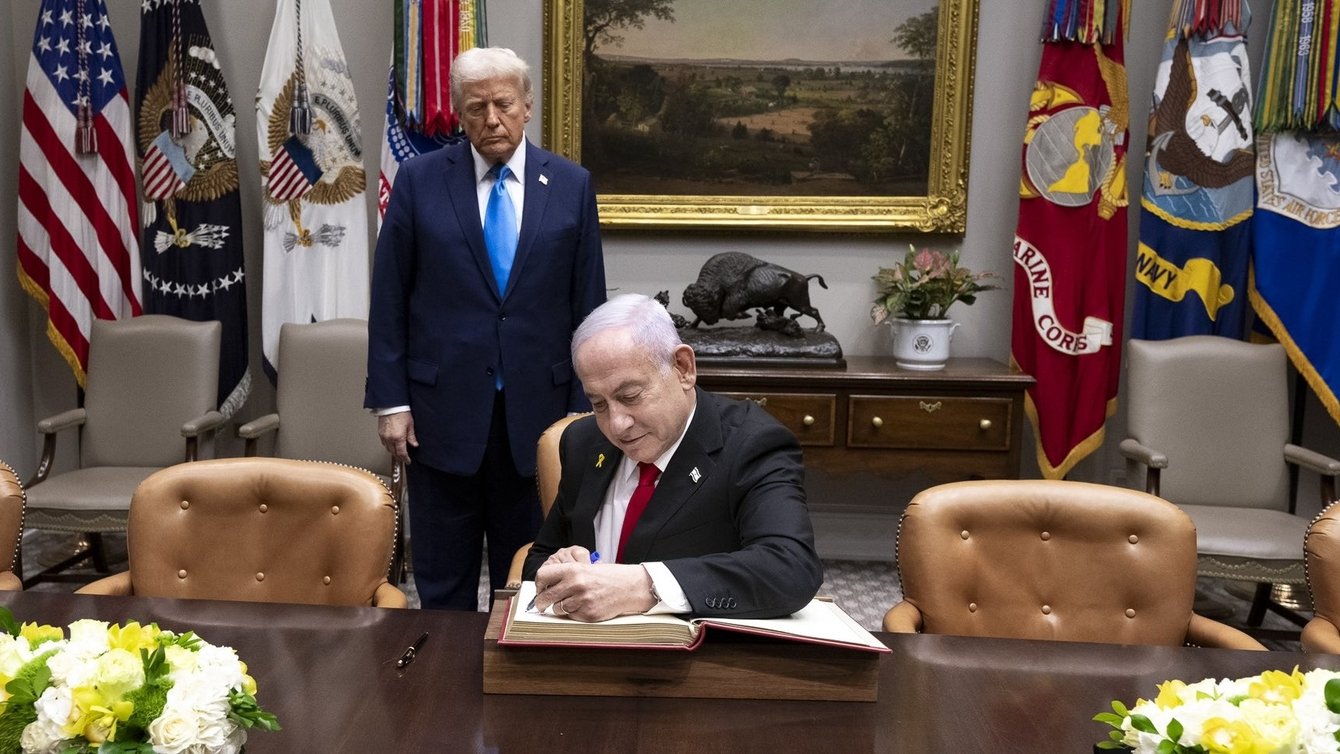
On February 28, 2026, the United States and Israel coordinated a joint attack on key political and military sites across Iran and Lebanon, beginning Operation Epic Fury. Reporting suggests that thousands of Iranians have been murdered (including children), and millions displaced amidst relentless bombardment, with thousands more killed in Lebanon.
Despite a tenuous ceasefire, the likelihood of further escalation remains high amid a U.S.-imposed naval blockade of the Strait of Hormuz. Negotiations have reached a stalemate, inflaming tensions that could lead to a resumption of outright war. Meanwhile, Israel continues to ethnically cleanse Southern Lebanon and kill hundreds in Beirut.
Justifications for the war have been haphazard, ranging from President Donald Trump’s claims that the U.S. is seeking to prevent Iran from attaining a nuclear weapon, to plans to “obliterate” their missile industry, seize or control the flow of oil and other resources, and protect Israel. Trump and his cabinet have also leaned heavily into genocidal rhetoric, threatening to bomb Iran “back to the stone age.” On April 7, Trump announced that “a whole civilization will die tonight, never to be brought back again”—a threat that analysts have deemed “the clearest case of declared genocidal intent in modern international criminal law.”
As PRA wrote in an April 2026 statement about this war, “Operation Epic Fury reflects the drive within MAGA, especially in President Trump’s second term, towards overt A form of top-down political system that concentrates state power in the hands of a single leader and/or group of close allies. Learn more and aggressive displays of militarism to reassert a vision of America First dominance on the world stage. Trump is not the first President to take the U.S. into war, but openly signaling genocidal intent while bypassing Congress and international allies reflects an authoritarian escalation that demands a serious response from anti-authoritarian and social justice movements in the U.S.”
Crafting an effective strategy to oppose this unpopular war requires an understanding of the authoritarian forces propelling it. Trump’s coalition is built from many sectors and factions of the Right that are motivated by diverse ideologies and interests, all jostling for influence within the administration. If the war continues, the MAGA bloc may continue to fracture under the weight of its own contradictions. While chaotic, this unpredictable political field also presents opportunities to build a new narrative and grow a pro-democracy coalition while marginalizing the Trump-aligned war hawks and profiteers behind this authoritarian escalation of foreign military action.
Military Imperialism as Authoritarianism
Operation Epic Fury is not an isolated instance of recent U.S. belligerence. It began only weeks after the U.S. military bombed Venezuela and abducted President Nicolás Maduro and his wife, and has to be understood in the context of the U.S.-backed Israeli genocide in Gaza and Southern Lebanon, and aggression towards Syria, Yemen, and Iraq. Escalation against Iran thus became a top priority for the Trump-Netanyahu alliance, as Iran remains an “obstacle” to pursuing a ‘greater Israel’ agenda of regional domination and expansion. After taking control of 58 percent of Gaza through the 2025 ceasefire “yellow line” military buffer, Israel’s sights are on its northern border again, 20 years after occupying Southern Lebanon from 1978 to 2000.
The war exploits a longstanding consolidation of war powers within the executive branch, a legacy that dates back to the War on Terror. Like previous military operations, President Trump did not seek prior approval from Congress. In fact, Speaker Mike Johnson (R-LA) even expressed concern that a Congressional war powers resolution would strip the President of his power to make military decisions as commander in chief. Attempts to restrict Trump’s moves in Iran have failed in the House and Senate, highlighting elected officials’ inability to reign in executive powers.
Beyond this, the Trump administration frames mass violence as necessary to consolidate its power at home and abroad. For Trump advisor Stephen Miller and other Generically used to describe factions of right-wing politics that are outside of and often critical of traditional conservatism. Learn more ideologues, spectacular military brutality is a method of domination that aims to inaugurate a ‘might makes right’ paradigm in the face of declining US global hegemony and the rise of a multipolar order.
“The Trump administration frames mass violence as necessary to consolidate its power at home and abroad.”
Right-Wing Sectors Behind the War
Amid such bluster, the Trump administration has not clearly explained the war’s goals to the U.S. public, and some have wondered why the administration would start an unpopular war with a high price tag during a cost of living crisis ahead of the 2026 midterm elections. This analysis cuts through the noise by identifying and breaking down key sectors of the Right that are driving and benefiting from the war: anti-Muslim ideologues; neoconservatives; the Israeli Right and its supporters (including Jewish and Christian Zionists); oil and war profiteers; and the tech oligarchs heading companies now contracting with the U.S. military.
Anti-Muslim Ideologues
The anti-Muslim Right is composed of different groups, but far-right think tanks and foreign policy centers have been the loudest proponents of a US-Iran military standoff. Pro-war MAGA politicians use the research and narrative frameworks of organizations like the Heritage Foundation, the America First Policy Institute, and the Center for Security Policy (CSP) to codify their anti-Muslim sentiment in domestic and foreign legislation and policy.
Since the Islamic Republic’s inception in 1979, these far-right ideologues have framed Iran as the ideological and material supporter of anti-Americanism internationally, especially in the Middle East. When President Obama signed the Joint Comprehensive Plan of Action (JCPOA, aka “Iran Nuclear Deal”), anti-Muslim far-right think tanks and neo-con politicians and elected officials were its loudest critics, along with Israeli Prime Minister Benjamin Netanyahu, who has attempted to maintain Israel’s nuclear monopoly in the region. In 2015, then Republican front-runner for president, Donald Trump, and Senator Ted Cruz (R-TX) held a rally at the Capitol to protest the deal. The CSP cosponsored the event with two other anti-Muslim groups, the Tea Party Patriots and Zionist Organization of America.
Months later, when President Trump first proposed a ban barring Muslims from entering the country, his press release cited a bogus CSP poll that claimed that 25 percent of Muslims in the U.S. believed violence against America was justified “as part of the global jihad”. Anti-Muslim think tanks readily produce discriminatory analysis and statistics to not only discriminate against Muslims in the U.S., but also to pursue genocidal foreign policy.
“Anti-Muslim think tanks readily produce discriminatory analysis and statistics to not only discriminate against Muslims in the U.S., but also to pursue genocidal foreign policy.”
Previous presidential administrations have typically constructed a cohesive narrative, however cynical, to sell foreign military intervention to the general public in the U.S. The lack of any such effort for this war illustrates the pervasive A form of religious bigotry, with strong racial components, that scapegoats & demonizes Muslims and those perceived to be Muslim. Learn more and dehumanization of Muslims, Arabs, and others in the SWANA region—not only among those who are pro-war, but across broad swathes of the U.S. public. Similar to the dehumanization of Palestinians and Arabs since the War on Terror and Israel’s genocide of Gaza, U.S. officials rely on Orientalist tropes to legitimize violence on Iranians to the whole world. Secretary of State Marco Rubio claimed that the “entire regime is led by radical clerics who don’t make geopolitical decisions; they make decisions on the basis of theology–their view of theology, which is an apocalyptic one.”
Such overt anti-Muslim rhetoric surging from the highest levels of the White House has emboldened elected officials to repeat anti-Muslim sentiment across social media—furthering violence and discrimination against and the othering of Muslim Americans, Arabs, and Iranians within the U.S. A March analysis by the Center for the Study of Organized Hate showed a sharp uptick in online anti-Muslim rhetoric following the start of the war.
Neoconservatives
For many decades, the neoconservative movement—a Beltway coalition of politicians, foreign policy operatives, media figures and intellectuals arguing for a hawkish U.S. foreign policy—has pushed for war on Iran. Figures like John Bolton and Paul Wolfowitz, and a coterie of think tanks like the Foundation for Defense of Democracies, Washington Institute for Near East Policy, and American Enterprise Institute helped drive decades of Western intervention in the Middle East, including the U.S.-led war in Iraq after 9/11, as part of a purported democracy-building agenda. Today, these organizations continue to lobby for the war, and the Trump administration has readily used materials from these groups to justify its campaign. Prominent neoconservative voices like conservative columnist Bret Stephens and political scientist Eliot Cohen lend support as well.
Some promoters of the war reject the much-maligned ‘neoconservative’ label and its associated agenda of democracy promotion. Conservative outlets like National Review or ‘national conservatives’ like Yoram Hazony instead profess to support a ‘realist’ or pragmatic war grounded in hard-headed calculations about power, allies and costs. Nonetheless, they borrow much of the neoconservative ideological framework, casting Iran and its allies as existential threats to U.S. and Israeli interests.
Meanwhile, a few neoconservatives such as Robert Kagan and Bill Kristol have criticized the war, surprising many observers. Far from a principled non-interventionist stance, however, these operatives argue that the war is poorly planned and risks undermining the imperial agenda they still support.
The Israeli Right and its Supporters
As noted above, the Israeli Right has advocated for the U.S. to wage war on Iran for many decades, warning that Iran poses an existential threat to Israel, the United States, and the broader ‘Western’ order. The Trump-Netanyahu alliance has turbocharged this agenda, especially in Trump’s second term. The seamless integration of the U.S. and Israeli militaries—and the significant influence of Israeli leaders on Trump’s decision to go to war—exemplifies the dangers posed by a global coalition of reactionary authoritarians imposing their will in brazen disregard of international law and human rights norms.
American supporters of the Israeli Right agenda and the broader U.S.-Israel ‘special relationship’ have beat the war drums against Iran, including neoconservatives, American Jewish and Christian Zionists, and portions of the foreign policy establishment. Major American Jewish groups like the Anti-Defamation League and the American Jewish Committee have voiced support for the war. While they claim to speak for the communal consensus, recent polling has shown solid majorities of American Jews do not support the war.
“The seamless integration of the U.S. and Israeli militaries…exemplifies the dangers posed by a global coalition of reactionary authoritarians imposing their will.”
Christian Zionists have been among this war’s most outspoken supporters. Some have celebrated Operation Epic Fury as a necessary precursor to the End Times. John Hagee, founder of Christians United for Israel, used one Sunday sermon to tell President Trump, “God bless you, Mr. President, for being a friend of Israel,” and claims that “God has an Operation [Epic] Fury he has planned for Iran and Russia.”
For decades, Hagee has argued that Iran’s nuclear ambitions portend global apocalyptic violence, and that regional war between Israel and its foes will signal the approach of The place where a final battle will be fought between good and evil, and/or a generalized term signifying the End-Times scenario. Learn more and the Second Coming. “The emerging crisis in the Middle East between Israel and Iran [is] part of a much bigger picture–that of God’s plan for the future of Israel and the entire world,” Hagee wrote in his 2006 book Jerusalem Countdown. “We are going to discover we are facing a countdown in the Middle East…a countdown that will usher in the end of this world.”
In March 2026, the Military The idea that people’s religious views should be neither an advantage or a disadvantage under the law. Learn more Foundation (MRFF), a military watchdog group, received reports from U.S. military officers claiming that commanders are casting the war as part of God’s End Times plan. In Congress, the most prominent advocate for the war has been Senator Lindsey Graham (R-SC), who in 2025 insisted that “if America pulls the plug on Israel, God will pull the plug on us,” and actively fear-mongers about the dangers of Iran having a nuclear weapon to justify the war. The leading office of the modern apostolic prayer networks that compose the New Apostolic Reformation (NAR). Learn more Paula White-Cain, senior advisor to the White House Faith Office and Israel Allies Foundation’s #1 top supporter of Israel, organized a gathering of Evangelical leaders at the Oval Office to pray for President Trump’s military action against Iran.
Oil and War Profiteers
For at least a century, U.S. and British oil, financial, and other business elites have sought to control Iranian petroleum reserves and trade flows in the region. In 1953, the CIA backed a coup against democratically elected Iranian Prime Minister Mohammad Mossadegh after he nationalized the Iranian oil industry. During the Cold War, and later, in the War on Terror, the West perceived the Islamic Republic as a chief obstacle to imperial dominance in the Middle East. Any prolonged campaign in the Middle East threatens global oil supply, and potentially disrupts major air transit routes and sea shipping lanes. With this in mind, many suggest that the U.S. operation on Venezuela was not merely a Heritage Foundation plan for reasserting dominance in the Western Hemisphere, but also a last-ditch attempt to control oil reserves as the Administration planned to escalate tensions in the Middle East. As the war continues, weapons manufacturers such as Lockheed Martin, Boeing, and RTX (Raytheon) stand to profit significantly from selling more bombs, drones, missiles, and planes to governments after munition depletion.
Tech Oligarchs
The war on Iran is accompanied by the unprecedented integration of Big Tech corporations and AI models like Claude into intelligence assessments, targeting decisions, and operational planning and execution on the battlefield. This cedes control over life and death decisions to companies like Palantir, and allows the military to launder war crimes as technological mistakes. As with the genocide in Gaza, Iran becomes a laboratory for U.S., Israeli, and global tech companies to battle-test the latest instruments of war. Palantir leadership, including CEO Alex Karp and co-founder Peter Thiel, have framed the war as inevitable, while Elon Musk has been uncharacteristically quiet regarding his thoughts on the war. Palantir and Musk’s SpaceX have recently won lucrative military contracts, positioning them to profit from the war.
Fractures within MAGA
Several critics of the war have emerged from within the MAGA coalition. Foremost among these is former Fox News host Tucker Carlson, followed by a wide range of pundits including Candace Owens, Megyn Kelly, and Nick Fuentes; operatives like Steve Bannon; ex-administration officials like former National Counterterrorism Center director Joe Kent; and even traditional hawks like Erik Prince, founder of the state-aligned mercenary group Blackwater and a longtime advocate of privatized warfare. Sometimes called the ‘America First’ wing of MAGA, this camp tends to argue that the war is a strategic error that will diminish American geopolitical dominance, drain taxpayer resources, and strengthen global competitors like Russia and China. Although they are often labeled ‘isolationists’ or ‘non-interventionists,’ this is a misnomer, as many of them support Trump-led intervention against named enemies such as China, or in regions such as Latin America.
For the time being, it remains unclear whether this opposition has made a serious and lasting dent in the MAGA base. One April poll showed that 67 percent of Republicans support the war, with 21 percent opposed, and among self-identified ‘MAGA Republicans’, support rose to 77 percent. Polling also suggests that support grows more muted among younger Republicans, and that many Republicans support a speedy end to the war and are concerned about rising gas prices.
Threats Go Beyond Another “Forever War”
No one knows how long this war will go on. However, as the war progresses, PRA has identified three threats that put social justice movements and others at risk:
- Political Repression occurs when public or private institutions—such as law enforcement agencies or vigilante groups—use arrest, physical coercion, or violence to subjugate a specific group. Learn more : The Justice Department and Department of Homeland Security may accuse social justice groups and anti-war protestors of being “Iranian sleeper cells” or “terrorists” to demobilize resistance to U.S. militarism abroad and growing authoritarianism at home. Such an effort would build on the consistent criminalization of pro-Palestine protestors since October 7, 2023, and the March 2026 verdict in the federal Prairieland case to prosecute anti-ICE protestors.
- Counterterrorism: The administration is expanding U.S. counterterrorism legislation and policy based on anti-Muslim narratives to target its political opponents and critics, particularly through the priorities emphasized in National Security Presidential Memorandum 7 (NSPM-7) and the newly created FBI and IRS Joint Mission Center. These investigations cast a wide net that will undermine human rights and civil liberties for everyone.
- Right-Wing Disinformation: Conspiracy theories and mass disinformation campaigns will push some people to the right, especially as the Far Right uses antisemitic conspiracy theories to explain Israel’s role in the war. Simultaneously, fear-mongering and intimidation could silence those who dissent.
The political and social infrastructure created during the war on Iran and Lebanon will outlast the war itself, regardless of how or when it ends. Some analysts have characterized it as a potential “forever war.” But the Right has been generating the conditions for this war for decades; through an increasingly authoritarian administration, they have finally triggered it, exposing the limits of the U.S. system of checks and balances. This reveals an important lesson for pro-democracy and social justice movements: As we develop strategies for blocking authoritarian policies at home, we can build critical movement infrastructure to connect our domestic agenda to the fight against imperial wars abroad—and build international solidarity with anti-authoritarian movements globally.
Behind the headlines of higher prices, disrupted shipping lanes, and the looming energy crisis are millions of people in the Middle East, particularly in Palestine, Lebanon, and Iran, who will be the nameless victims of this authoritarian war after nearly three years of U.S.-backed genocide in Gaza and Lebanon. Being anti-war is anti-authoritarian—but not only in the U.S. This also means being accountable to the world and the U.S. imperial war machine’s victims, wherever they may be.