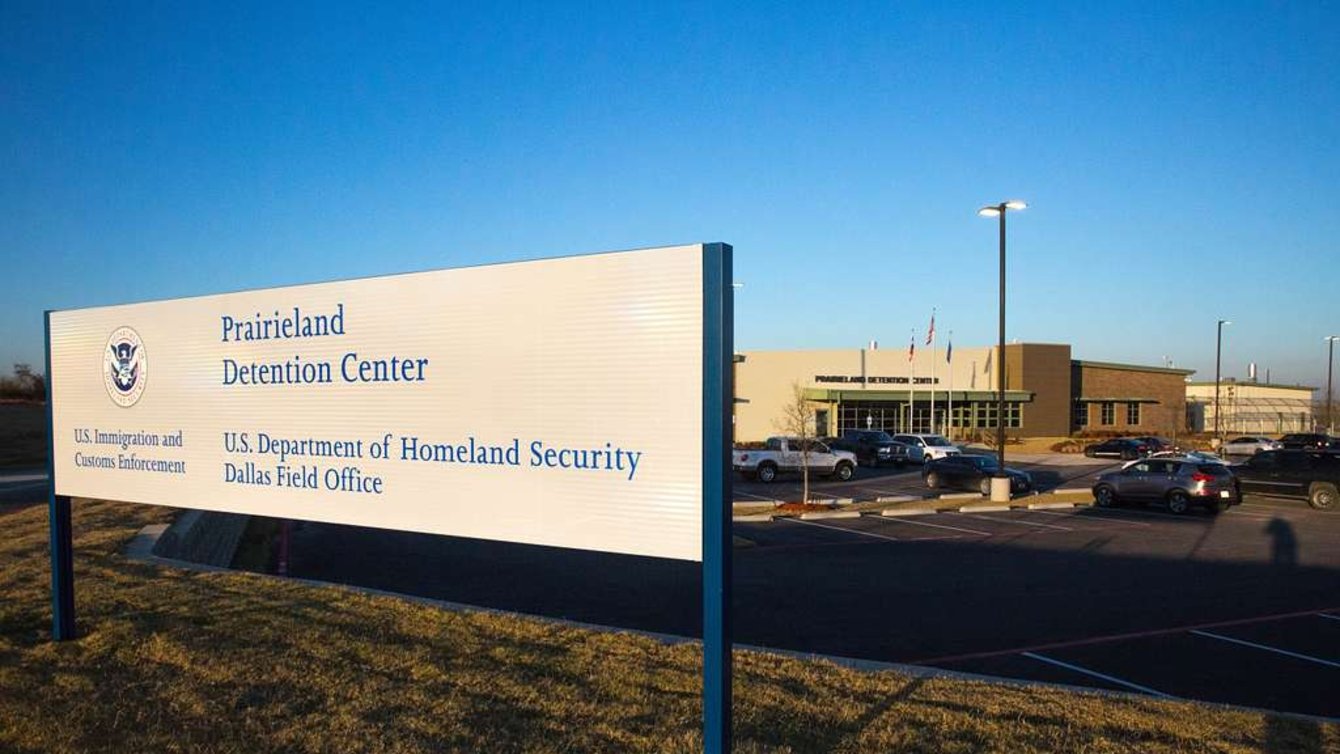
On Independence Day, 2025, a group of activists organized a noise demonstration with fireworks at the Prairieland Immigration and Customs Enforcement (ICE) detention center in Alvarado, Texas. What happened afterwards is disputed, but a confrontation between police officers and protestors escalated. A gun was discharged, injuring a police officer.
Twelve protestors were arrested that night and in the following days. Over the next six months, seven more people were violently detained for being accessories after the fact, despite not being physically present at the demonstration.
The federal case against these 19 people—known as the Prairieland Defendants—marks the Department of Justice’s first effort to indict anti-ICE protestors on terrorism charges for allegedly being part of an “Antifa Cell.”[Footnote 1]
On March 13, 2026, a federal jury delivered a guilty verdict to eight defendants for various charges, including riot, attempted murder of a police officer, conspiracy to use and carry explosives, and material support for terrorism. The anti-ICE activists are expected to be sentenced this month.
The Prairieland Defendants are the first test subjects for two federal policies that the Trump administration announced in September 2025: Executive Order: Designating Antifa as a Domestic Terrorist Organization (hereafter the Executive Order, or EO), and the National Security Presidential Memorandum-7 (NSPM-7). Although these directives followed the events at Prairieland, the government used these new anti-terrorism policies to enhance the charges and punishments that the defendants received. The Prairieland case reveals how authoritarian federal policymaking is being weaponized against social justice movements to criminalize activists and further silence dissent.
The new policies expand on post-9/11 legal and policy frameworks, using the framing of “domestic terrorism” to include political opponents of the regime. Existing frameworks, particularly Countering Violent Extremism programs, have targeted racial, ethnic, or religious groups that the Department of Homeland Security and the FBI deemed “suspect.” Now, the entire population lives in a “pre-crime” space of constant legal suspicion with the threat of enhanced surveillance and prosecution.
How Federal Policies Criminalize Dissent Based on Ideology
The Far Right and security state have exploited the September 2025 murder of Charlie Kirk to pass authoritarian policies that vilify and criminalize progressive activists and groups, political dissidents, and opponents in the name of combating “domestic terrorism.” Stephen Miller, Deputy Chief of Staff and Homeland Security Advisor, claims that the broader Left and Democrats have resorted to violence to prevent the administration from implementing its agenda, especially around border enforcement. He has vowed “to use every resource we have at the Department of Justice, Homeland Security and throughout this government to identify, disrupt, dismantle and destroy these networks and make America safe again for the American people,” in Kirk’s name. By “these networks,” Miller is referring to “antifa”—or antifascist networks—an umbrella term the Far Right has used to stoke fears of an insurgent Left amid growing dissent and unpopularity.
The September 2025 EO designates “antifa” as a “domestic terrorist organization”—but this is a designation that does not currently exist in U.S. law. Previous legislation defines acts as domestic terrorism, not organizations or political affiliations. “Domestic terrorism” is a label, not a chargeable federal offense, despite most states having statewide domestic terrorism laws and charges, including “support to terrorism” charges. Under NSPM-7, law enforcement agencies like the FBI, IRS, DHS, and DOJ, among others, are now encouraged to submit to the President a list of groups and entities that espouse and promote “domestic terrorism.”
The White House factsheet accompanying the EO appears to reference Prairieland, alleging that “Antifa has engaged in armed standoffs with law enforcement, […] threatening public safety.” Both the EO and factsheet direct all federal agencies to “investigate, disrupt, and dismantle all illegal operations conducted by Antifa or any person claiming to act on behalf of Antifa” and their funding sources. This would prevent protests like the one at Prairieland from happening by empowering law enforcement to stifle activists and dissenters before they mobilized.
“This is not the first time the Trump administration has attempted to turn political opponents—or even those deemed ‘Antifa’—into criminals.”
Of course, this is not the first time the Trump administration has attempted to turn political opponents—or even those deemed “Antifa”—into criminals. During the 2020 protests for police accountability after George Floyd’s murder, Trump tweeted that “The United States of America will be designating ANTIFA as a Terrorist Organization.” At that time, the FBI and Congress agreed that Trump’s Twitter decree would be a First Amendment violation and did not go through with the order. Today, a more authoritarian administration is deviating from political precedent to criminalize dissenters.
The White House Determines What Domestic Terrorism Is
The new policies go beyond designating and criminalizing a specific ideology. Three days after passing the Executive Order, the White House issued a national security memorandum (NSPM-7) identifying indicators of “domestic terrorism” and how the federal government will identify, investigate, and prosecute individuals and entities that express or espouse the following views based on “common threads”:
- anti-Americanism
- anti-capitalism
- anti-Christianity
- support for the overthrow of the United States Government
- extremism on migration, race, or gender
- hostility towards those who hold traditional American views on family, religion, and morality
The threats identified are broad, creating a wide net that continues the legacy of The act of favoring members of one community/social identity over another, impacting health, prosperity, and political participation. Learn more and bias of past counterterrorism and counterextremism programs while expanding the government’s target beyond racial and religious minorities. This inevitably erodes civil liberties for everyone. The memorandum lays out a justification for violating First Amendment rights by suppressing speech and expression, without any evidence of these ideologies being dangerous.
For instance, during the Prairieland trial, federal prosecutors presented evidence that was intentionally vague as proof that the defendants were “domestic terrorists.” At a DFW Support Committee meeting, a group working to support the Prairieland defendants, a volunteer made clear the implications when he asked the audience: “If you’ve ever been to a protest, raise your hand. Raise your hand if you have ever worn all black, in general, not even at a protest. Raise your hand if you have a first aid kit. If you own a gun, raise your hand. If you’ve ever used Signal, raise your hand.” A fellow volunteer posed the next question: “If you raised your hand, does that make you a terrorist?”
What This Means for Activists and Social Justice Movements
The state is constructing the legal framework to criminalize resistance—ideological or physical—as part of a larger fear-mongering campaign. The designation of dissident groups as domestic terrorist organizations is not based on the frequency, danger, or pervasiveness of an alleged crime they may have committed, but on the group’s political ideology. Even while the Executive Order “designates” antifa as a terrorist organization, there is no legal process for this designation, nor does the Order specify how it will create and enforce this designation.
“The state is constructing the legal framework to criminalize resistance—ideological or physical—as part of a larger fear-mongering campaign.”
What is unique about these policies is their scope. They subject anyone in the U.S. to political scrutiny. As a result, consultant companies, law offices, and nonprofits have released statements about how to protect themselves. These policies aim to chill speech and political mobilization in a moment where communities are organizing and actively dissenting.[Footnote 2]
Enlarging the Scope of “Material Support for Terrorism”
Most concerningly, this has stretched the limits of what prosecutors will consider as evidence for “supporting” terrorism, especially for nonprofits. NSPM-7 instructs the IRS to investigate and potentially prosecute groups, individuals, and entities accused of funding or otherwise supporting “domestic terrorism.” Existing federal “material support for terrorism” laws are currently being expanded through legislation such as H.R. 9495 (Stop Terror-Financing and Tax Penalties on American Hostages Act) and H.R. 6408 (To amend the Internal Revenue Code of 1986 to terminate the tax-exempt status of terrorist supporting organizations). Despite stalling out in Congress, these “nonprofit killer bills” are used to criminalize nonprofits—including charities, schools, and religious institutions—that financially support Palestine, or anything the government deems “terrorism.” Though it builds on a decades-long history, this authoritarian revocation of constitutional rights based on political ideology and mobilization escalated when mass protests began against Israel’s genocide in Gaza, and has been used to criminalize Stop Cop City protestors via RICO and domestic terrorism charges.
Courts and prosecutors disagree about whether other activities like translations, interactions, interviews, and publishing constitute “material support.” At the heart of this debate is whether speech that is protected by the First Amendment can be used as evidence for a crime. The Executive Order opens the door to penalizing constitutionally protected speech and expressions of solidarity—including donations—which isolates movements and organizers from their base and chills public action. Take the case of Daniel “Des” Sanchez, one of the Prairieland Defendants who was not at the noise demonstration. He was arrested for “corruptly concealing a document or record,” for transporting anarchist zines and pamphlets in his car after his wife was arrested at the noise demonstration. This indicates that law enforcement thinks they have “found a constitutional loophole — if you can’t punish reporting it, punish transporting it.”
“The Executive Order opens the door to penalizing constitutionally protected speech and expressions of solidarity…which isolates movements and organizers from their base and chills public action.”
Extending the Use of Joint Terrorism Task Forces
Both the Executive Order and the NSPM-7 use Joint Terrorism Task Forces (JTTF)—multidisciplinary partnerships between local and state law enforcement and federal intelligence agencies that are overseen by the FBI—to identify, investigate, and prosecute those who espouse the indicators listed above. This is not new, as the FBI has used JTTFs with state and local law enforcement to investigate and prevent potential terrorist attacks since 2001.[Footnote 3] JTTFs have been surveilling and intimidating protesters since at least 2004, and they have not stopped despite several legal challenges by civil liberties organizations. During the first Trump Administration, DHS and the FBI had categorized five “domestic terrorism” threats subject to JTTF activity.
In a May 2024 Freedom of Information Act Request submitted to the FBI, DOJ, and DHS, the ACLU requested “records created from January 20, 2017, to the present concerning the definition of the following terms as used and applied by JTTFs.” The requested terms included “antifa,” “far-left extremists,” “violent instigators,” and “criminal organizers and instigators.” Several months later, the ACLU filed a lawsuit against the same agencies for failing to respond to their FIOA request. The lawsuit highlights how the Executive Order and NSPM-7 empower JTTFs to continue their past practices of surveilling protestors and activists and infiltrating communities of color without due process, transparency, or evidence. This builds on past efforts to “discredit, disrupt, and destroy” Civil Rights groups and Black leaders, anti-war activists and socialists, and other “subversives” during COINTELPRO; and the use of JTTFs against Black and Indigenous communities, Arabs, Muslims, South Asians, immigrants, and progressive movements during the Global War on Terror.
Where to next?
The Prairieland Defendants were not the first “domestic terrorists.” On the other side of the Prairieland ICE detention center gates, Leqaa Kordia, a Palestinian woman detained by ICE, sat in a jail cell for her participation in Columbia University’s Palestine encampments. Kordia was detained by ICE in Newark, New Jersey on March 13, 2025, exactly a year before the Prairieland Defendants heard their guilty verdicts.[Footnote 4] In that single year, the category of “domestic terrorist” expanded from Palestine solidarity activists, to anti-ICE protestors, to an artist with a box of zines—and now, an ever-expanding list of potential opponents.
Anyone can be “antifa” now—the next “domestic terrorist,” the next target of authoritarian federal policy. In its budget proposal for the 2027 fiscal year to Congress, the White House proposed a $445 billion increase in military spending, while cutting $73 billion from essential domestic programs. The FBI’s budget request revealed that the agency recently created the NSPM-7 Joint Mission Center (JMC) to “counter domestic terrorism.” As the administration funnels resources into swallowing its enemies, foreign or domestic, countering “domestic terrorism” becomes an institution, with infrastructure that requires offices, staffing, funding, and prisons.
“Anyone can be ‘antifa’ now—the next ‘domestic terrorist,’ the next target of authoritarian federal policy.”
The Prairieland Trial makes clear how executive edicts, even when they lack legal grounding or violate constitutional protections, can still be weaponized to criminalize dissent with the full backing of prosecutors, judges, and juries. If anyone can be a terrorist now, social justice movements must create counternarratives disproving the administration’s assertions, as well as the normative, anti-Muslim, anti-Arab, anti-Black, and A term used to describe organizations, movements, ideas, and policies that oppose immigrants and immigration. Learn more national security framework that got us to this point. It is more than a warning for social justice movements and activists: authoritarian policies are being tested in courtrooms and on our communities, with serious consequences for activists and the broader struggle for justice.
- To learn more…
Defending Rights and Dissent, “The Dangerous Precedent of the Prairieland ‘Antifa’ Trial,” YouTube, April 8, 2026, https://www.youtube.com/watch?v=uqL0Vjn7az4.
Ken Klippenstein, “Exclusive: FBI’s New Political Pre-Crime Center,” Substack, April 5, 2026, https://www.kenklippenstein.com/p/fbis-new-political-pre-crime-center.
Muslims for Just Futures, “MJF Statement and FAQ on Threats to Designate Domestic Groups on the Left as Terrorists,” January 14, 2026, https://bit.ly/EOAnalysisDes.
Simone Weichselbaum, “Why Some Police Departments Are Leaving Federal Task Forces.” The Marshall Project, October 31, 2019, https://www.themarshallproject.org/2019/10/31/why-some-police-departments-are-leaving-federal-task-forces.